“What is non-functional harmony?” (A tribute to Wayne Shorter)

In our recent tune “Messenger” we paid tribute to the late Wayne Shorter. In addition to his work as a saxophonist, both as a band leader and a sideman with artists ranging from the Jazz Messengers and Miles Davis to Steely Dan and Don Henley, Shorter was known as an influential jazz composer. One characteristic of his writing was his use of non-functional harmony.

What exactly is non-functional harmony? Perhaps it can be more easily defined by what it isn’t. Non-functional harmony is different from atonality in that it still often features familiar major and minor chords and can have a key center, but the harmonic movement does not follow typical patterns. If atonal music might be compared to abstract art, music with non-functional harmony could be compared to impressionism. According to www.beyondmusictheory.org, non-functional harmony “occurs when no chord ‘wants’ to specifically resolve to the next one…more often than not, the goal is to evoke a mood, feeling or atmosphere…” As this article from Berklee Today points out, creating non-functional harmony is “not so much deciding which techniques to use…but which ones to avoid. Functional harmonic patterns (like II-V-I patterns, dominant to tonic resolutions, circle of fifths sequences, and line clichés) contribute to harmonic predictability and set up expectations in standard tunes.”

Indeed, traditional jazz standards often used II-V-I cadences and other established harmonic building blocks. Many early be-bop staples were reworkings of older tunes, such as Charlie Parker’s “Ornithology”, which used the same chord progression as “How High the Moon.” Some tunes, including “Joy Spring” by Clifford Brown and “Airegin” by Sonny Rollins, had progressions that were more intricate than those of the Great American Songbook era, but still followed similar patterns.

However, following Miles Davis’s “Kind of Blue”, jazz musicians started to break away from the status quo. In the 1960s, Wayne Shorter left his mark on the jazz canon with “Ju-Ju”, “Speak No Evil”,“Virgo” and other tunes which explored new harmonic territory. His boundary-stretching as a composer continued into the 1970s with Weather Report and subsequent solo albums such as “Native Dancer” and “Atlantis.” His compositions were praised for being unpredictable while, thanks to his melodic and rhythmic sensibilities and deliberate chord choices, also accessible to a wide audience. 

Composers and songwriters in jazz and other genres looking to break out of common chord progressions might find inspiration in the non-functional harmonies of Shorter and his contemporaries. In the following three examples, we will look at how Wayne Shorter uses non-functional harmonies to create unpredictable tunes while also using traditional techniques such as motivic development to maintain a sense of structure and continuity.

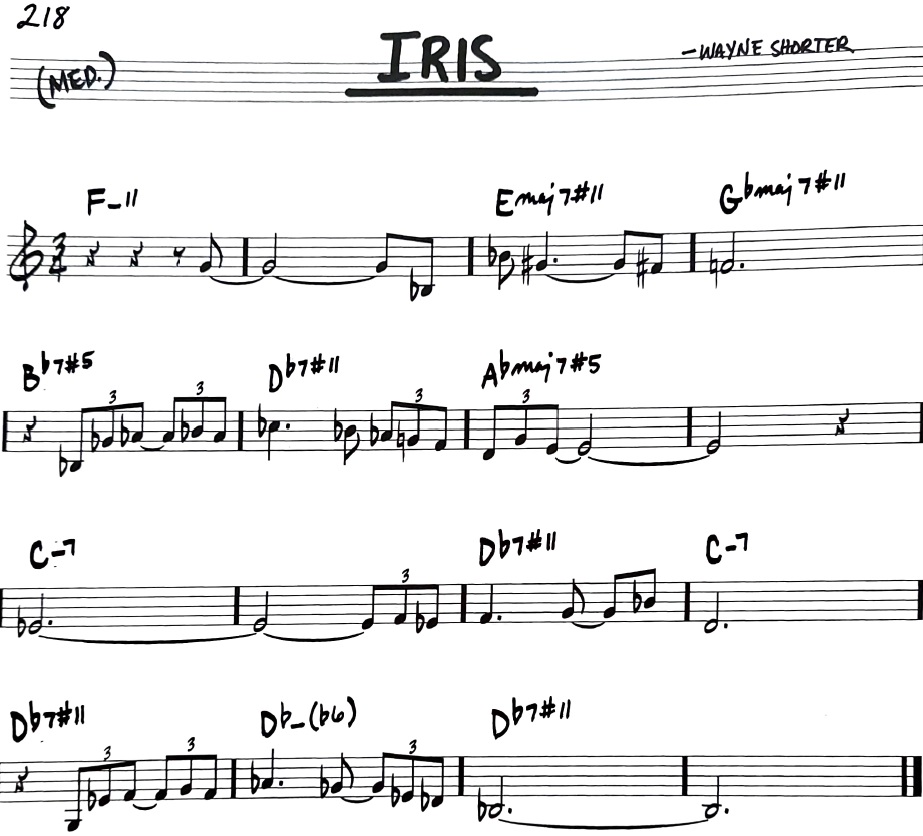
The harmonies of “Iris” (1965) have roots in the modal jazz of “Kind of Blue”; the half step movement from Cm7 to Db7 back to Cm7 in bars 9 to 12 recall “So What.” However, while the harmonic rhythm of “Iris” maintains the leisurely pace of modal jazz (no chord is held for less than a full measure and four chords are held for two measures), the movement of the chords is less predictable. The Fm11 of the first two bars seems to establish a tonality, only to move to Emaj7 in the third bar and Gbmaj7 in the fourth. The sparse melody enables the listener to digest these changes; though the harmonic movement is not what we expect, the overall effect is not jarring. Bars 5 to 8 introduce a contrast, both in the activity of the melody and in the chord quality: we have two consecutive altered 7th chords, providing variety from the major and minor 7ths of the first phrase. While not a resolution in the traditional sense, the Abmaj7#5 of 7-8 feels like a pause after the prior two busy measures, even with the tension of the E natural in the melody. In the second half of the tune, the melody echoes that of the first half, providing some continuity over the new chords. In the last line, Shorter creates harmonic ambiguity by alternating between dominant 7th and minor chords in a way that is rarely seen in more traditional chord progressions.
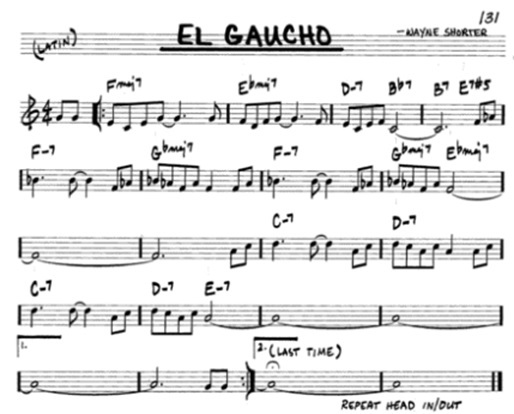
In “El Gaucho” (1966), Shorter uses a recurring melodic motif to bring unity to a non-functional chord progression. In the second measure, the motif is repeated higher than in the first, while the harmony moves lower (F to Eb). In the third measure, the motif appears in its original register over a different chord (D minor). The fourth measure appears to be setting up a move to an A tonality (B7 to E7 as a II7-V7), but instead of the expected resolution, the harmony moves back to F, this time minor. By returning to the original tonality via an unexpected route, Shorter employs non-functional harmony in a way that still fits the structure of the tune. Variations of the four-note motif continue over different chords: Gbmaj7 in measures 6 and 8; Dm7 in measures 12 and 14.
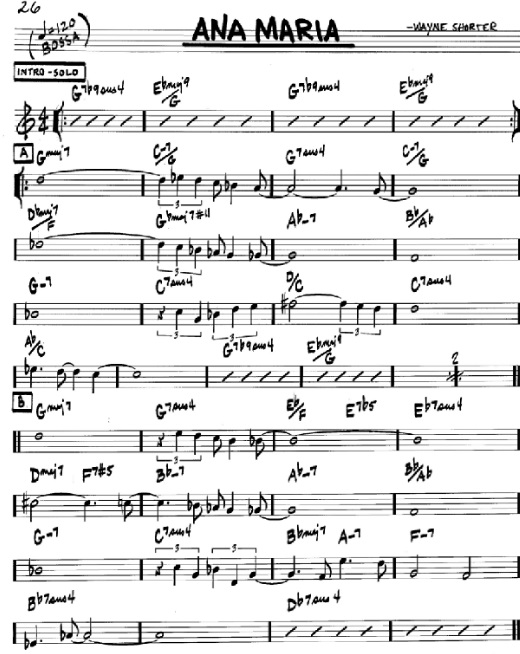
Ana Maria” (1975) starts with a progression based around a G pedal. Shorter seems to be building tension that will release to a C tonality (the traditional V-I movement), but he remains in G when the main tune begins. A variation on the first motif is heard over a new tonality in the fifth bar of the “A” section. In the ninth bar, the G tonality returns, now minor. The “B” section begins in the same way as the “A” (Gmaj7) before varying both the melody and harmonies. Because the change in the melody is subtle (E descending to Bb, compared to Eb descending to A), Shorter is able to make a more dramatic change in the harmonies: instead of the G pedal, the bass notes now move downward chromatically, arriving at a Dmaj7 chord in the fifth bar of the “B” section. However, after this variation, the next three bars are the same as the corresponding three in the “A” section. Bar 10 of “B” begins in the same manner as its “A” counterpart before diverging again, moving to Bbmaj7, Am7 and Fm7. We see again how, while the chords don’t follow traditional patterns, they don’t feel chaotic thanks to Shorter’s use of recurring motifs and strategic decisions about when and where to move tonalities.
The opening of our tribute tune “Messenger” uses non-functional harmony inspired by Shorter. The bass line is a tetrachord: D-E-F-G while the triads placed on top of these notes, C, B, Eb and F, don’t fit together in a traditional way. The second measure features another tetrachord in the bass: A-B-C-Db, with more new chords on top: E-F#-D-Ab. However, the chords are played in the same rhythm, serving as a common thread. 

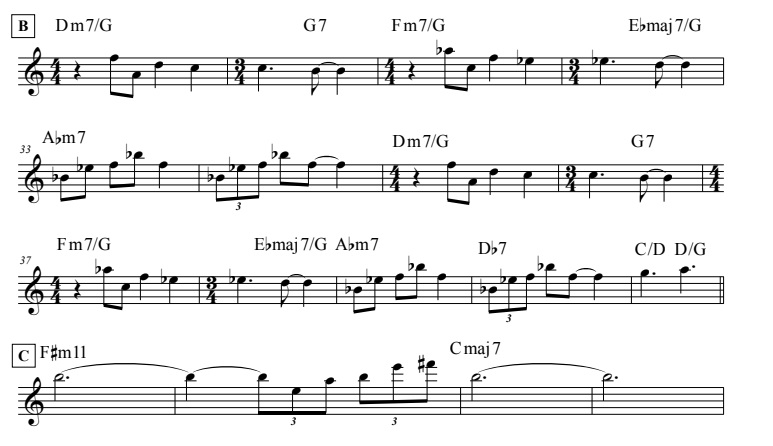
Since the introduction is busy, a slower harmonic rhythm in the “A” section creates variety. The first two chords, F#m11 and Cmaj7, are not related, but are tied together by the melody note of B. After leaving the Cmaj7 chord, the root motion ascends: D – Eb – F, setting up a return to F#m11 in bar 13. However, the chords then diverge from the previous “A” section, with the root motion climbing: G#, A, B. Bars 5 to 11 are repeated verbatim from 21 to 27, but a new chord – F#dim7 at measure 28 – sets up the “B” section.

This section is built around pedal points – first G, then Ab – which contrast the movement of the harmonies, starting out in D minor, moving by minor thirds to F minor and then Ab minor. At measure 39, there is a hint of a ii-V-I progression, with Abm7 and Db7 breaking away from the stepwise root motion that has been common up to this point. The progression eventually will resolve, but not in an expected way: two non-functional hybrid chords in bar 41 (C/D and D/G) create uncertainty before the return of the original theme at “C”. Without measure 41, the root motion would resemble a ii-V-I, but it would still be somewhat unconventional in that the I is minor and the enharmonic equivalent (F# rather than Gb).
How can a tune with only chords be so difficult to play? (An introduction to modal jazz)

As John Coltrane was preparing to unleash a new harmonic concept on the jazz world that would challenge improvisers for generations to come, another album featuring the tenor saxophonist as a sideman was released. “Kind of Blue” by Miles Davis similarly changed the landscape of jazz composition and improvisation, not by doing more, as “Giant Steps” did, but by doing less. 

Like most musical genres and subgenres, the definition of “modal jazz” is somewhat open to interpretation. As defined by Peter Spitzer on the Jazz Standards website, modal jazz is “organized in a scalar (horizontal) way rather than in a chordal (vertical) manner.” According to the Jazz Piano Site, characteristics of modal jazz include “sparse chord changes where a single chord can last many bars” – contrasting both the harmonically dense chord progressions of the Great American Songbook era and the be-bop era, as well as the new direction represented by “Giant Steps.” This gives “the soloist greater freedom and choice while improvising.” 

However, with freedom comes responsibility, and while not having to navigate the hurdles of an intricate be-bop progression might seem like a relief after spending time with the Charlie Parker Omnibook, modal jazz is proof positive of the idea that simple and easy aren’t the same thing. In this post, we will talk about the challenges that modal jazz presents to improvisers and rhythm section players alike. We will look specifically at the progression of “So What”, the tune from “Kind of Blue” that perhaps more than any other embodies modal jazz.

Navigation 

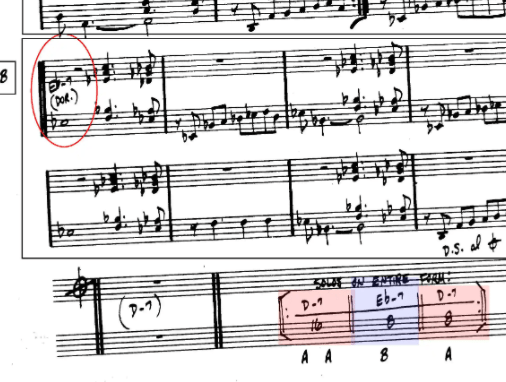
The progression is a 32-bar A-A-B-A form in which each A is 8 bars of Dm7 and the B is 8 bars of Ebm7. Thus, playing through one chorus would produce sixteen bars of Dm7, eight bars of Ebm7 and eight bars of Dm7. Without signposts such as ii-V-I turnarounds that are common in jazz, the improviser doesn’t have much to get their bearings.

It’s a challenge for the rhythm section as well. As Outside Pedestrian bassist David Lockeretz recalls, “I first started playing this tune when I was still studying jazz guitar. When I got lost, which was often, I’d listen to the bass player to try to figure out where I was. Later on, after I started playing bass, I got lost playing this tune and out of habit started listening to the bass player. For some reason, that no longer worked.”

Indeed, even as the improviser needs to keep their place, the rhythm section, including the drums, can help by framing each 8-bar phrase, especially the transition to the Ebm7 chord and the top of each chorus. At the risk of stating the obvious, the rhythm section must be sure of where they are in the progression as well. Lockeretz: “One thing that’s helped me be more solid on modal progressions is to think in 2- and 4-bar phrases with my walking. Typically, as a bassist, you usually play the root at the beginning of each measure, because in many jazz standards, most harmonies aren’t held for more than a measure, so there’s a new chord on each downbeat. However, in modal jazz, if I played D on the downbeat for sixteen bars in a row, it would get monotonous. It’s easier to think of four four-bar phrases or even eight two-bar phrases than it is to think of sixteen one-bar phrases. I might play a 2-bar phrase such as D-E-F-G | A-C-B-E or a 4-bar phrase such as D-E-F-B | C-E-D-B | A-Ab-G-F | G-G#-A-Eb. Using non-diatonic notes sparingly, especially as approach notes, can make the part more interesting while still staying within the modal sound. Also the example that I gave above assumes you’re playing straight quarter notes – a few well-timed kicks and fills can make the part more interesting while continuing to support the soloist.”

For ideas on comping behind a modal jazz soloist, check out this article.

More with less

Another challenge of modal jazz is creating a solo with less raw harmonic material. Improvisers soloing over a standard chord progression may have the benefit of modulations or other compositional devices that can create tension and release. Modal jazz improvisers won’t get much help from the composer. As Spitzer notes, “By de-emphasizing the role of chords, a modal approach forces the improviser to create interest by other means: melody, rhythm, timbre and emotion.” 

How to tackle this challenge? In an article on the Learn Jazz Standards website, author Josiah Boorzanian suggests, “Try to come up with melodic patterns that aren’t so symmetrical…for example, leap up a 7th, then down a 3rd, then up a 2nd, then down a 5th…prioritizing asymmetry can lead to the discovery of new and exciting ideas.” 

Borrowing from outside the parent scale (such as d dorian on “So What”) is another tool for the improviser. This article suggests: “Try playing lines based on the D-flat or E-flat scales for a measure or two. This dissonance creates tension, which you can release by returning to the original scale.” 

It’s been done…or has it?

Though the techniques required to play “Giant Steps” and “So What” may be different, they present a common challenge to today’s improvisers: how to say something new with a standard that has been part of the literature for over 60 years. One of the first standards to emulate “So What’s” modal progression, Coltrane’s “Impressions” – considered by many to be the 1b of modal jazz to “So What”’s 1a – solved the problem by playing the progression much faster. Since then, many artists have interpreted “So What” in a variety of genres, including acoustic/Americana, funk, vocal and more. “Impressions” has also seen its share of contemporary interpretations, including this one in the funk/fusion vein, and this synth-oriented version

Other modal jazz progressions

In the 60s, standards such as “Maiden Voyage” by Herbie Hancock and “Little Sunflower” by Freddie Hubbard used the sparseness of modal jazz while expanding upon the “So What” progression; notably in the quartal harmonies of “Maiden Voyage.” The Doors used the influence of modal jazz in “Light My Fire” as described by keyboardist Ray Manzarek: “It’s John Coltrane’s ‘My Favorite Things’ and Coltrane’s ‘Ole Coltrane’…it’s basically a jazz structure…state the theme, take a long solo, come back to stating the theme again.” This article highlights a few lesser-known modal jazz gems from the last few decades. One last example of a more contemporary modal tune is this one, which just so happens to be written and performed by some pretty good friends of ours. 

So what?

As with the Coltrane changes, one might ask why bother learning a 60-year old progression and genre. Even if one doesn’t play modal jazz, or play jazz at all, tackling the musical challenges of the genre will make them a more well-rounded musician. “Less is more” is not a one size fits all solution and for some musicians, it’s just not their sound. However, all musicians can benefit from awareness of the idea, as expressed by Miles Davis himself, that “it’s not the notes you play. It’s the notes you don’t play.”

Why is music written in a particular key?

Image courtesy of Ethan Hein

Why do composers and songwriters write their music in a particular key?

As a composer, instrumentalist or even as a listener, understanding key centers and why they are chosen can be useful. Certain key centers have been historically associated with particular concepts or moods; for example, A and G have been considered “military” keys while E-flat (key of Beethoven’s “Eroica” symphony and “Emperor” concerto) is considered royal or heroic. The characteristics of particular keys even works its way into the rock’n’roll parody film “This Is Spinal Tap” in which Christopher Guest’s character describes d minor as “the saddest of all keys.” 

There can be any number of reasons why a musician can elect to choose a particular key center for writing or performing. For many singer-songwriters, the key is often chosen to fit their own vocal range. Instrumentalists who write their own music might similarly be influenced by the strengths or limitations of their instrument. On the piano, the keys of C major and a minor are the most accessible, as their diatonic scales consist of all natural notes. On the other hand, stringed instruments are often better suited to the “sharp” side of the Circle of Fifths, in keys such as G, D, A and E and woodwinds are aligned for the “flatted” keys such as F, B-flat and E-flat.

When writing music, trying new keys can be a good way to break out of ruts, either for finding inspiration for a new piece or fine-tuning an existing one; for example, if a piece feels as if it is missing something, playing it in a different key might shed new light on it and make it feel more complete. For composers who write on and for a specific instrument, breaking out of the commonly used keys for that instrument can be a good technical challenge and a way of exploring new sounds. Guitarists and other stringed instrumentalists in particular can explore new sounds even without the technical demands of non-friendly keys by tuning down or using capos and electronic keyboards can be manipulated to accomplish the same thing.

Following are a few examples of why certain Outside Pedestrian tunes have been written in specific keys.

Instrumental considerations

Since O.P. is a guitar and bass oriented band, much of the music has been written on those instruments. 

Open strings

Anthony Fesmire: The open strings on the guitar have a particular color, brought out in the Em9 chord at the beginning of “The Sound” and the power chords at the beginning of “Dream.”

David Lockeretz: In ‘Marbakki’, by writing it in the key of D and using drop-D tuning, the first three notes are all played on open strings, which fills up space. Filling up space without necessarily playing more notes is a goal with O.P. because there are only two melodic instruments. In ”Marbakki” in particular, there are no harmonies or counterpoint, so being able to play those three notes on open strings is a big part of how the tune sounds. The bass riff in “Northern California Highway Song” has a similar origin. By setting it in g minor, the first three notes – G, A, D – are all open strings, and that fills up the space.

Fretted notes instead of open strings

Sometimes on a guitar or bass, a fretted note offers advantages an open string doesn’t have.

Lockeretz: “Rattlesnakes” is in f minor because even though the melody is pretty intricate, the harmonies are simple and the bass spends a lot of time on that low F [first fret on the lowest string]. Having it as a fretted note, rather than an open string as it would have been in the key of e minor, gives me more choices for articulating it. I can mute with either hand, instead of just the right. Also, the tune was originally written for a pre-Outside Pedestrian band that had an alto sax player and by playing it in f minor, the highest note of the melody was the same as the highest note on the alto, which helped give it the sharpness we were looking for. At one point we tried playing it in d minor and something was missing. It didn’t have the same punch.

Range

Fesmire: Depending on the composition, it may be necessary for chords, melodies, etc. to fall in a low, middle, or high range on an instrument to achieve the proper effect. For example, the A section of “Tower One” uses chord voicings that move progressively higher. In this case, A was chosen as the key center to accommodate the climbing nature of this section.

Other considerations

Key center journey

Not all music stays in the same key from start to finish; in fact, if you find yourself stuck, jumping to a new key center can be a good technique for unlocking new ideas. Sometimes, simply repeating the same material in the new key can be enough to move the composition forward; the jazz standard “What’s New” features an A-A-B-A- form in which the B section is the same as the A, but in a different key.  

Fesmire: If a composition moves through a variety of key centers, the original key will impact those relationships. For example, my tune “Dream” starts in e minor and moves to g minor (an adaptation of the relative major). G was used because of its relationship to E. 

Contrafacts

A contrafact is a piece of music based on a previous work. Charlie Parker was one of the first jazz musicians to extensively explore the concept: His tune “Donna Lee” is based on the old swing standard “Indiana” and another of his signature compositions, “Ornithology” is based on “How High the Moon.” A more recent example is Mike Stern’s tune “One-Liners”, based on the standard “Softly As In A Morning Sunrise.” 

Outside Pedestrian contrafacts include “Tweaked” (based on “Speak No Evil” by Wayne Shorter) and “Jake’s Shuffle” (based on “So What” by Miles Davis). A contrafact does not have to be in the same key as its source material, but it’s a logical place to start. 

Where do you hear it?

Sometimes the seed of an idea comes when the composer is not near an instrument. If the composer is able to keep the fragment in their head, when they get to an instrument (assuming they don’t have perfect pitch) they can figure out the key in which they first internally heard the idea. 

Lockeretz: I came up with the riff for “Big Leo” when I was away from any instrument. When I got a chance to play it, I figured out that I was hearing it in c-sharp minor. I don’t think I’d ever tried writing anything in that key, so I decided to go with it.  

Additional resources

Article about the characteristics of musical keys

Article about why composers might pick a certain key

Article with examples of jazz contrafacts

How we create virtual performances

This edition of “Ask OP” is a response to some questions we’ve received about our recent video about creating virtual performances. It is a written summary of and supplement to the material covered in the video. 

THE ZOOM CALL

Our first step is a Zoom call in which we discuss what song to perform, if we want to make any changes to the arrangement, or in the case of our performance of “Jesu, Joy of Man’s Desiring” to create the arrangement. Since we have not been able to rehearse or even visit with each other in person since before the pandemic, interacting via Zoom, rather than just on a conference call, makes the meeting feel more inspiring.

THE CHART AND THE PLAY-ALONG

Using either Finale or its offshoot PrintMusic, a lead sheet for the arrangement is created and shared via Google Drive. Anthony Fesmire then creates a play-along track with Logic Pro X, including MIDI drums and bass with a scratch guitar part. The track is then mixed down, both with and without bass and sent to David Lockeretz.

Virtual Performance blog post image 01

ADDING THE PARTS

David Lockeretz, using a PreSonus Audiobox USB 96 with Studio One software, imports the file and adds his bass track. After completing it, he sends just the bass track back to Anthony, who imports it back into Logic Pro X. The new track is then sent to David Oromaner, who adds his drums in the same manner, also with Logic Pro X. With a completed rhythm section track in place, Anthony adds his final guitar parts. 

Virtual Performance blog post image 02a

Importing the play-along and exporting the finished bass track. Note in the second image that the play-along is muted so only the bass is heard in the mix that is sent back. Note too how the date is part of the file name to help make sure that the most recent version of the track is being used.

MIXING AND MASTERING

After the rough mixes are finished and heard by all the band members, Anthony will do a final mix and then master the track. 

VIDEO

As we are recording the audio tracks, we also record video on our smartphones or computer cameras. David Lockeretz sometimes prefers to record the video and audio components separately: “This approach can take longer, but I like being able to focus on one thing at a time. By locking in the audio recording that I’m happy with and then filming myself playing along to it, I feel looser when I’m doing both steps. On a tune like ‘Northern California Highway Song’ where there’s a bass solo, however, this approach doesn’t work as well because it’s hard to replay something that’s improvised. If just a note or two is off, I can let it slide, but I don’t want it to be obvious.” 

After the videos are completed, Anthony puts them together with the audio track in Final Cut Pro.

Virtual Performance blog post image 03

CHALLENGES OF REMOTE RECORDING AND VIRTUAL PERFORMANCES

According to David Oromaner, “The biggest challenges are time and communication. When you’re doing something remotely, if you have an idea, instead of mentioning it face to face, you have to send an email and you’re waiting for the response. You’re waiting for someone to get back to you, which could take a day or two. But the end result is really inspiring in that we are all in different parts of the country and can still do this kind of work together.”

Lockeretz adds, “It does require a few extra steps; my parts tend to be more ambiguous at first, leaving the other players different options for what they can add on. After I hear what one of them did, I may end up changing my part. The convenience of digital recording is a blessing and a curse: it’s great to be able to record a part from my own home on my own schedule, but it’s tempting to keep editing and tweaking beyond the point of which the track actually sounds better.”

WILL OUTSIDE PEDESTRIAN CONTINUE TO RECORD REMOTELY AND PERFORM VIRTUALLY?

Lockeretz: “As a geographically spread-out band, yes. In 2020, we did a total of four virtual performances, complete with new audio and video, and we also did some short promos for Anthony’s new solo record, so we are getting used to the process, figuring out what works best for us. Of course, we are looking forward to playing and recording in person when circumstances permit, but if there’s been one good thing to come out of the pandemic for us it’s that we were inspired to explore this new way of creating music.”


Here is another article about creating a virtual performance.

Blog at WordPress.com.

Up ↑