How can a tune with only chords be so difficult to play? (An introduction to modal jazz)

As John Coltrane was preparing to unleash a new harmonic concept on the jazz world that would challenge improvisers for generations to come, another album featuring the tenor saxophonist as a sideman was released. “Kind of Blue” by Miles Davis similarly changed the landscape of jazz composition and improvisation, not by doing more, as “Giant Steps” did, but by doing less. 

Like most musical genres and subgenres, the definition of “modal jazz” is somewhat open to interpretation. As defined by Peter Spitzer on the Jazz Standards website, modal jazz is “organized in a scalar (horizontal) way rather than in a chordal (vertical) manner.” According to the Jazz Piano Site, characteristics of modal jazz include “sparse chord changes where a single chord can last many bars” – contrasting both the harmonically dense chord progressions of the Great American Songbook era and the be-bop era, as well as the new direction represented by “Giant Steps.” This gives “the soloist greater freedom and choice while improvising.” 

However, with freedom comes responsibility, and while not having to navigate the hurdles of an intricate be-bop progression might seem like a relief after spending time with the Charlie Parker Omnibook, modal jazz is proof positive of the idea that simple and easy aren’t the same thing. In this post, we will talk about the challenges that modal jazz presents to improvisers and rhythm section players alike. We will look specifically at the progression of “So What”, the tune from “Kind of Blue” that perhaps more than any other embodies modal jazz.

Navigation 

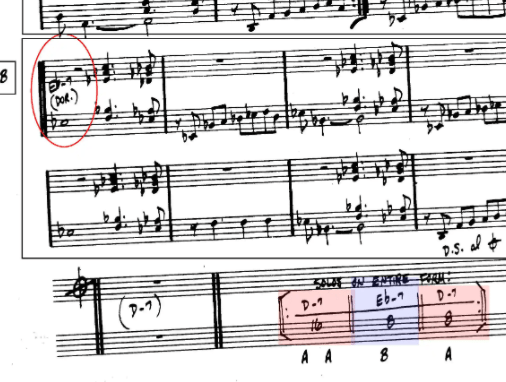
The progression is a 32-bar A-A-B-A form in which each A is 8 bars of Dm7 and the B is 8 bars of Ebm7. Thus, playing through one chorus would produce sixteen bars of Dm7, eight bars of Ebm7 and eight bars of Dm7. Without signposts such as ii-V-I turnarounds that are common in jazz, the improviser doesn’t have much to get their bearings.

It’s a challenge for the rhythm section as well. As Outside Pedestrian bassist David Lockeretz recalls, “I first started playing this tune when I was still studying jazz guitar. When I got lost, which was often, I’d listen to the bass player to try to figure out where I was. Later on, after I started playing bass, I got lost playing this tune and out of habit started listening to the bass player. For some reason, that no longer worked.”

Indeed, even as the improviser needs to keep their place, the rhythm section, including the drums, can help by framing each 8-bar phrase, especially the transition to the Ebm7 chord and the top of each chorus. At the risk of stating the obvious, the rhythm section must be sure of where they are in the progression as well. Lockeretz: “One thing that’s helped me be more solid on modal progressions is to think in 2- and 4-bar phrases with my walking. Typically, as a bassist, you usually play the root at the beginning of each measure, because in many jazz standards, most harmonies aren’t held for more than a measure, so there’s a new chord on each downbeat. However, in modal jazz, if I played D on the downbeat for sixteen bars in a row, it would get monotonous. It’s easier to think of four four-bar phrases or even eight two-bar phrases than it is to think of sixteen one-bar phrases. I might play a 2-bar phrase such as D-E-F-G | A-C-B-E or a 4-bar phrase such as D-E-F-B | C-E-D-B | A-Ab-G-F | G-G#-A-Eb. Using non-diatonic notes sparingly, especially as approach notes, can make the part more interesting while still staying within the modal sound. Also the example that I gave above assumes you’re playing straight quarter notes – a few well-timed kicks and fills can make the part more interesting while continuing to support the soloist.”

For ideas on comping behind a modal jazz soloist, check out this article.

More with less

Another challenge of modal jazz is creating a solo with less raw harmonic material. Improvisers soloing over a standard chord progression may have the benefit of modulations or other compositional devices that can create tension and release. Modal jazz improvisers won’t get much help from the composer. As Spitzer notes, “By de-emphasizing the role of chords, a modal approach forces the improviser to create interest by other means: melody, rhythm, timbre and emotion.” 

How to tackle this challenge? In an article on the Learn Jazz Standards website, author Josiah Boorzanian suggests, “Try to come up with melodic patterns that aren’t so symmetrical…for example, leap up a 7th, then down a 3rd, then up a 2nd, then down a 5th…prioritizing asymmetry can lead to the discovery of new and exciting ideas.” 

Borrowing from outside the parent scale (such as d dorian on “So What”) is another tool for the improviser. This article suggests: “Try playing lines based on the D-flat or E-flat scales for a measure or two. This dissonance creates tension, which you can release by returning to the original scale.” 

It’s been done…or has it?

Though the techniques required to play “Giant Steps” and “So What” may be different, they present a common challenge to today’s improvisers: how to say something new with a standard that has been part of the literature for over 60 years. One of the first standards to emulate “So What’s” modal progression, Coltrane’s “Impressions” – considered by many to be the 1b of modal jazz to “So What”’s 1a – solved the problem by playing the progression much faster. Since then, many artists have interpreted “So What” in a variety of genres, including acoustic/Americana, funk, vocal and more. “Impressions” has also seen its share of contemporary interpretations, including this one in the funk/fusion vein, and this synth-oriented version

Other modal jazz progressions

In the 60s, standards such as “Maiden Voyage” by Herbie Hancock and “Little Sunflower” by Freddie Hubbard used the sparseness of modal jazz while expanding upon the “So What” progression; notably in the quartal harmonies of “Maiden Voyage.” The Doors used the influence of modal jazz in “Light My Fire” as described by keyboardist Ray Manzarek: “It’s John Coltrane’s ‘My Favorite Things’ and Coltrane’s ‘Ole Coltrane’…it’s basically a jazz structure…state the theme, take a long solo, come back to stating the theme again.” This article highlights a few lesser-known modal jazz gems from the last few decades. One last example of a more contemporary modal tune is this one, which just so happens to be written and performed by some pretty good friends of ours. 

So what?

As with the Coltrane changes, one might ask why bother learning a 60-year old progression and genre. Even if one doesn’t play modal jazz, or play jazz at all, tackling the musical challenges of the genre will make them a more well-rounded musician. “Less is more” is not a one size fits all solution and for some musicians, it’s just not their sound. However, all musicians can benefit from awareness of the idea, as expressed by Miles Davis himself, that “it’s not the notes you play. It’s the notes you don’t play.”
Is “Giant Steps” really the hardest jazz standard to play?

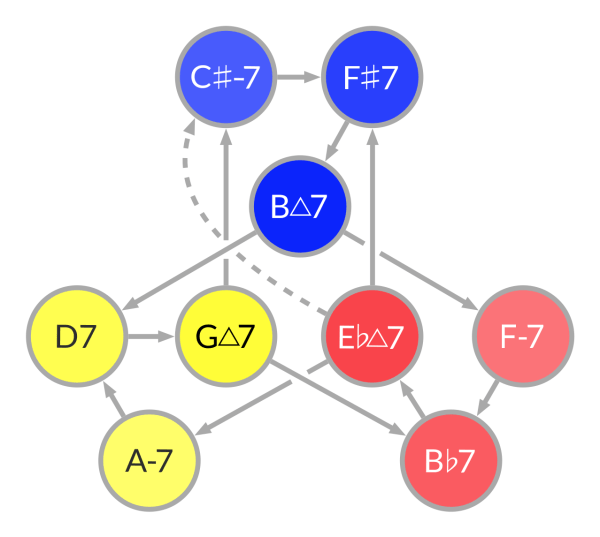
Image courtesy of Ethan Hein

For rock guitarists, it’s Van Halen’s “Eruption.” In classical music, it’s “Flight of the Bumblebee.” For bluegrass banjo pickers, “Foggy Mountain Breakdown.” Every genre of music has one work that, more than any other, serves as a rite of passage. You don’t have to spend years in the jazz community to know which tune fits that role.

Whether John Coltrane’s “Giant Steps” is the most difficult jazz standard of all time is a matter of opinion, but most would agree that more than any other contender, its name serves as shorthand for improvisation intimidation. Vox calles it “the most feared song in jazz.” The Jamey Aebersold series has a volume devoted entirely to helping students master the progression. Ever since pianist Tommy Flanagan struggled with the changes at the original recording session, jazz musicians have seen mastery of the “Coltrane Progression” as the genre’s holy grail. Like ultra-marathoners or actors who have worked for a notoriously demanding director, most jazz musicians have a “Giant Steps” war story or two. The tune has been a reference point for more than half a century. How many jazz standards become memes?

Since the 60th anniversary edition of Giant Steps with the all the  previously unreleased alternate takes drops today, I reckon Flanagan memes  are back on the table : jazzcirclejerk

What makes “Giant Steps” difficult? The two main things are that it is usually played very fast (Coltrane’s original recording was north of 300 beats per minute) and that the chord progression constantly jumps from one key center to another, making it an obstacle course for the improviser. Once the musician can navigate the chord changes, there is the challenge of making it their own. Since ‘Trane, multiple generations of musicians from Pat Metheny to New York Voices have performed and recorded it, so saying something new musically with it is not easy. 

All that being said, what are the advantages of learning “Giant Steps” more than 60 years after it was first recorded? 

Even those who never plan on performing “Giant Steps” can still glean benefits from learning it.  While every chord progression presents its own requirements, the process of acclimating to “Giant Steps” – finding an approach, practicing and perfecting it – and the musical vocabulary developed as a result can be applied almost anywhere: bluegrass, metal and more. Think of the Farmers Insurance commercial – “We know a thing or two because we’ve seen a thing or two.”

Spending time with “Giant Steps” can also provide a lesson in musical history. Like most seemingly radical innovations, “Giant Steps” didn’t come out of nowhere. Wikipedia cites Rodgers and Hart’s “Have You Met Miss Jones” as an influence: “The song’s bridge, featuring key motion by thirds, may have served as an inspiration to John Coltrane in the development of the ‘Coltrane changes.'” Going back even farther, Coltrane was also influenced by Nicolas Slonimsky’s “Thesaurus of Scales and Melodic Patterns.” Musicians who worked with Coltrane during the “Giant Steps” era report that he carried the book around everywhere. 

Another advantage of playing “Giant Steps” is that after spending time with it, almost everything else will seem effortless by comparison, just as after training at high altitudes, an athlete will find competing at sea level to be easier. There’s an old joke about a guy hitting himself with a hammer. When asked why he is hitting himself with a hammer, he says, “It feels so good when I stop.”

Since “Giant Steps” several challenging jazz tunes have entered the literature and shown some staying power. Jaco Pastorius’s “Teen Town” is a benchmark for bassists, as is Mike Stern’s “Chromazone” for guitarists and Michael Brecker’s “Syzygy” for saxophonists. Still, it seems unlikely that another standard will capture the imagination of the jazz world quite as “Giant Steps” did. As the study of jazz continues to grow in years to come, so will “Giant Steps” and its infamous and inspiring legacy.

What are some ways to break out of “ruts” in improvisation?

It’s easy to get stuck in a routine. You find something that works and you want to stick to it. You rely on the same few riffs for your solos and they get you through the gig–but ultimately you want more. We have seen many students go through this; even veteran musicians feel stuck from time to time. We’ve had those moments ourselves. To that point, here are a few ideas about how to break out of ruts and come up with fresh new improvisational ideas.

Practice the chord progression slower. When you take a familiar chord progression – a 12-bar blues, a jazz standard, a modal progression – and play it slower than you are used to, you will hear it differently.  Your phrasing and note choice will automatically sound unlike how it sounded before.  Riffs that sound good at 120 beats per minute might not sound as good at 80 and vice versa.  You may find it awkward and not like how it sounds, but as with any part of your musical experience, ideas and concepts often have to feel uncomfortable before they feel comfortable.  You can also try playing the progression faster than you are used to, but since it’s usually more of a challenge to play slowly, try doing that first.

Practice the chord progression in different keys. Being comfortable improvising in any key is a great benchmark for any musician to attain.  Certain instruments are aligned to play well in specific keys – “C” for the piano; “E” or “A” for guitar; “G” for banjo; “B-Flat” for trumpet, etc.  If you are playing in a key that is friendly to your instrument, it’s easy to revert to familiar riffs.  If you force yourself outside of that comfort zone, you may discover new ideas that you can translate back to the original key.

One note. There’s a lot of focus on: “What scale should I play?  What tensions should I use?”  This is important stuff, but there’s plenty more that goes into an effective solo.  By picking just one note and creating a solo with it, you can focus on dynamics, phrasing, articulation and other elements of improvisation that sometimes take a back seat to note choice.

Two on, two off.  Solo for two measures; leave space for two measures.  Get used to the sound of space; it is a valuable improvisational tool.

Sing along. If you are playing piano, guitar or any other non-wind instrument, sing along with yourself as you play.  It will force you to play lines that are more purposeful.  If you play a wind instrument, try singing along to the chord progression and then improvising over it; you may find that singing, instead of being tied to your instrument, gives you new ideas.

W.W.T.D.? What would Trane do?  Or Miles?  Hendrix?  Metheny?  Stevie Ray?  Listen, transcribe and find out.

Take a break.   You don’t have to solo on every single song your band or ensemble plays.  If you knew that during your set you would only have one or two solos, you would likely save your best ideas for them.  Plus, allowing other people the chance to solo in your stead will make you very popular on the bandstand.

“How do you get started with jazz improvisation?”

At one of our College of the Desert clinic, we were asked this question by a student. While there are many possible answers to that question, here are a few of our thoughts.

“The biggest thing to remember with improvisation is that there ARE no wrong notes. There may be notes that sound better than others, but a great musician can ‘sell’ a note that’s not ‘supposed’ to go over a certain chord or harmony. Notes also make up only part of what a musician communicates. Don’t forget phrasing, tone, dynamics, rhythm and space.

For some students, the ‘blank canvas’ of improvisation can be a little intimidating, just as for the novice jazz listener it can be hard to understand exactly what’s going on in a Bird or Coltrane solo. The more you listen to jazz, whether on recording or live, the more you will pick up.

Start by quoting the melody of the tune. This can make your solo feel more coherent; you’re trying to tell the audience a story, not just show them how fast you can play. For guitarists, pianists, vibraphonists, bassists and other non-wind instrumentalists, try singing along as you play. It doesn’t have to be perfect; that’s not the point. The point is that by singing along with your line, you’re likely to play more musically. Every note and phrase you play will have a purpose, even if they’re not executed 100% accurately. For phrasing, try the “two on, two off” exercise – that is to say, on a progression such as a 12-bar blues or a jazz standard, solo for two bars and then rest for two, as if you’re trading with a drummer.

As for the language of jazz and the ability to navigate over chords, there are many transcriptions of great jazz solos available. The Charlie Parker Omnibook is a good place to start. Playing the arpeggios of chord symbols (Cm7 = C, Eb, G, Bb; F7 = F, A, C, Eb; Bbmaj7 = Bb, D, F, A) is a good exercise too. In addition to reading the transcriptions of other soloists, try transcribing solos yourself–and not just those played on your own instrument.

Realize that trial and error is part of the learning process. With software such as Garage Band, it’s possible to record yourself improvising along to existing tracks. Some of what you play won’t work; some of it will probably make you cringe, but that’s how you grow.”

Blog at WordPress.com.

Up ↑