Recognizing, understanding and creating jazz contrafacts


The term “contrafact” is defined by Wikipedia as “a musical work based on a prior work.” In jazz, the word is often used to describe a tune that uses an existing composition’s chord progression. A songwriter or composer can use an existing chord progression as a starting point for a new piece, while musicians learning a tune that is a contrafact can gain additional insight by comparing it to its source. Note that from a copyright standpoint, chord progressions are not considered specific enough to qualify as intellectual property, so as long as the composer creates an original melody, they are exempt from charges of plagiarism.

In this post, we will discuss two common chord progressions: the 12-bar blues and the “I Got Rhythm” changes, then explore some specific examples of contrafacts.

Blues progressions

Blues music, in particular the 12-bar progression, has served as the foundation of many songs throughout jazz, country, bluegrass, rock and other genres. Works that are based on this progression usually have three things in common: starting on the I chord (the home key), moving to the IV chord in the fifth bar and a turnaround starting in the 9th bar: a phrase that “answers” the statements if the previous two phrases and sets up a return to the top of the form.

Following are three examples of the 12-bar blues progression in the key of F. The first is a basic example. The second is Charlie Parker’s tune “Au Privave” which shares the same outline as the first example but has more active harmonic movement. The third, “Blues for Alice” is another Parker head with the same framework, but still more movement.

Comparing “Au Privave” (a typical example of “be-bop” blues) to the simpler blues progression, we see differences, but also some similarities. Both of these progressions:

  • Start on the I chord (F)
  • Go to the IV chord (Bb) in the 5th measure
  • Return to the I chord in the 7th measure
  • Start the turnaround phrase in the 9th measure

The first progression uses a V – IV – I turnaround (the 9th measure has a C7, or V7 chord; the 10th measure has Bb7, the IV chord and the 11th measure returns to the I chord) while “Au Privave” uses a ii – V7 – I turnaround (starting on the Gm7, or ii chord, then going to the C7, or V7 chord, then resolving to the F7, or I chord.)

Comparing “Au Privave” to “Blues for Alice” we again notice similarities and differences. The progression starts on the I chord as the other two do, but it quickly moves through several harmonies before resolving on the IV chord in measure 5. Instead of returning to the I chord in measure 7 as the previous progressions do, it continues to explore new harmonic terrain before arriving at the ii chord in measure 9 as “Au Privave” does. From that point on out, it follows the same progression as “Au Privave.”

As a performer, understanding how a simple blues progression can evolve into a more elaborate one such as “Blues for Alice” can help you see the progression as a whole, enabling you to not worry too much about each individual chord. As a composer, seeing how far you can go from the original blues progression and still have the basic framework intact can give you ideas about how to stretch your raw materials farther.

“I Got Rhythm”

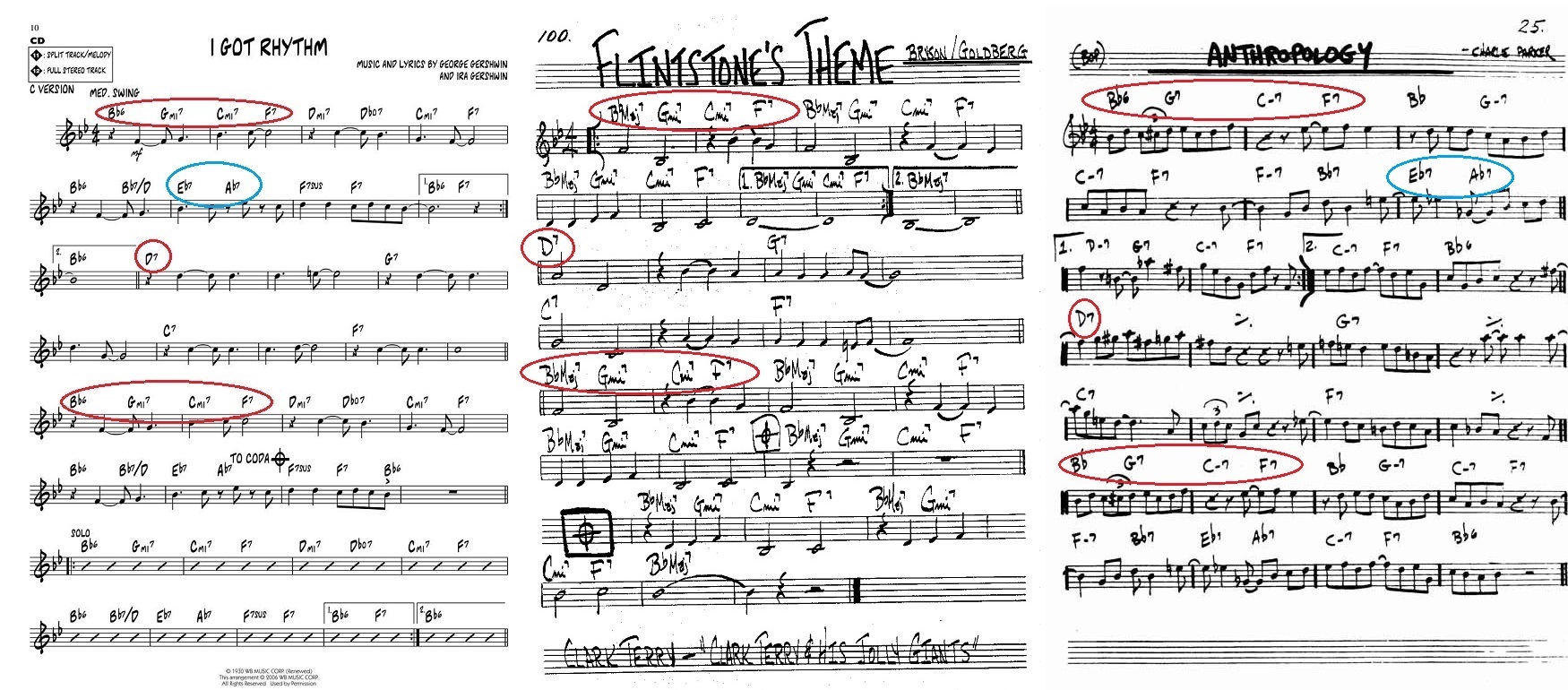
Gershwin’s “I Got Rhythm” has a chord progression that has been used by many jazz musicians as the basis for their own compositions. The theme from “The Flintstones” is a commonly cited example of “Rhythm Changes.” Other famous be-bop standards that use Rhythm Changes include “Oleo” by Sonny Rollins and “Anthropology” by Charlie Parker. A more recent example is saxophonist Alison Young’s “One Night Stan.” The progression also made its way into rock’n’roll with the Four Seasons’ “Sherry.” 

Comparing “I Got Rhythm” to “Flintstones” and “Anthropology” we see several parallels. All three follow a 32-bar “A-A-B-A” form. The “A” sections consist of a repeated two bar I-vi-ii-V7 progression (Bb6 – G7 or Gm7 – Cm7 – F7). In “I Got Rhythm” and “Anthropology” there’s the slight variation (circled in blue) of going to the Eb7 and Ab7 chords in the 6th measure. These tunes all have bridges that follow a III7-VI7-II7-V7 progression (D7 – G7 – C7 – F7) with each chord being held for two bars. Changing up the harmonic rhythm from one section to another (note how the chords in the “A” section move quickly while the chords in the “B” section last for longer) is a useful compositional tool to keep in mind should you feel stuck. 
Other be-bop era examples

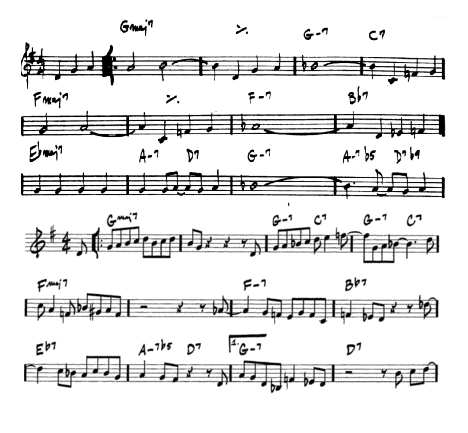
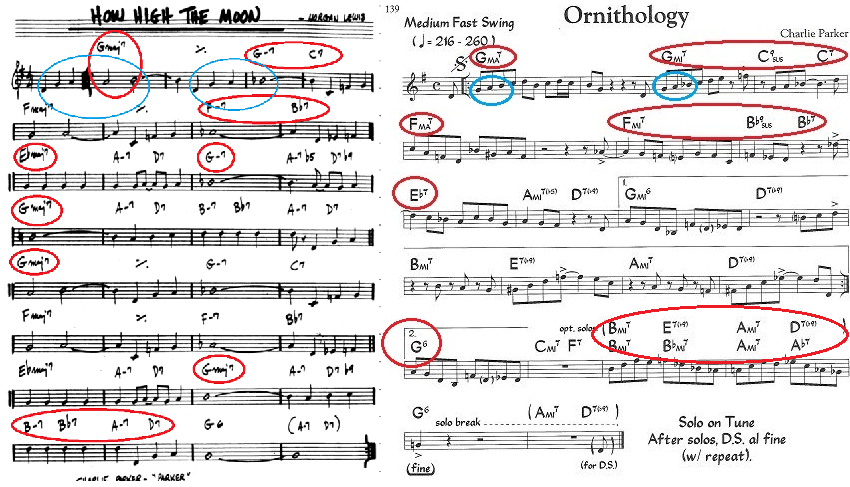
Several Great American Songbook era standards were used by the first generation of be-bop musicians (Charlie Parker, Dizzy Gillespie, Miles Davis et. al) as the basis for new compositions. A famous example is Parker’s tune “Ornithology”, based on “How High The Moon.” Comparing the two, we see some similarities. Both use 32-bar A-B-A-C (or A-B-A-B’) forms. Both start in the key of G, then switch from major to minor in the 3rd bar, setting up a move to F in the 5th bar. Another major to minor move in bar 7 brings us to E-flat in the 9th bar. The melody of “Ornithology” echoes “How High the Moon”’s D-G-A-B figure (circled in blue) in the first bar and the D-G-A-Bb figure in the third bar when the harmony shifts to minor.
The roots of a contrafact can be a little harder to trace when the new composition is in a different key than the original. However, by looking at relationships between the chords, we can still see parallels. An example of this is Parker’s “Donna Lee”, composed and usually played in the key of A-flat and based on “(Back Home Again in) Indiana”, usually played in the key of F. Though they look different, closer examination reveals that they follow the same blueprint. Like the pair discussed above, both are 32-bar A-B-A-C tunes. Both start with a I-VI7-II7 cadence (F – D7 – G7 or Abmaj7 – F7 – Bb7), then return to the I chord in bar 7. Both arrive at the IV chord in bar 9, use either the #iv diminished or the iv minor chord in bar 10 and return to the I chord in bar 11 before an extended turnaround sets up the next A section. At bar 23, both tunes have modulated into the relative minor (d for “Indiana” and f for “Donna Lee.”) Both tunes use a diminished chord in bar 28 as a pivot to return to the home key at the end of the form.

As a composer, comparing “Donna Lee” and “Indiana” can provide valuable insight into how one piece of music can be elaborated upon and transformed into something else. As an improvisation-oriented performer, understanding the roots of “Donna Lee” – a tune that has something of an intimidating reputation in jazz circles – can help give the musician a place to start learning it.

“Jake’s Shuffle”

Composer David Lockeretz on “Jake’s Shuffle”

I had a young student named Jake who was a fan of classic rock and blues. One day I came up with a riff that I thought he’d have fun playing. The riff sounded like it belonged on the turnaround of a Delta-style blues progression, but I decided to make it the main riff of the tune rather than using it as the turnaround. When I was messing with it, I decided to stay in the I chord instead of going to the IV chord in the fifth bar, as would be typical for a blues progression. I was in the key of D, with drop-D tuning, which Jake enjoyed, and that got me thinking about “So What” and “Impressions” – the two seminal modal jazz tunes, both of which are in that key. I decided to take that modal progression – 16 bars of D, 8 bars of Eb, 8 bars of D – and play it with the blues feel. I did some things to change it up a little – I started off with a vamp, brought in an element of orchestration by having the bass double the guitar on the turnaround line and I also wrote a new melody on the bridge, whereas “So What” and “Impressions” play the melody up a half step on the bridge. Long story short: “Jake’s Shuffle” didn’t start out as a contrafact, per se, but as I was developing it I realized that it might work with the modal progression. Once I saw that, it gave the tune a ready-made outline.

Additional resources

Articles with examples and analysis here and here

Article about baritone saxophonist and prolific contrafact composer Gary Smulyan here

Partial list of notable jazz contrafacts here

Playlist with contrafacts paired with their source material here

One last example

“Tide” by Antonio Carlos Jobim is a Latin jazz contrafact. Listen to it and see if you can identify the original progression and its composer.

What are some ways to break out of “ruts” in improvisation?

It’s easy to get stuck in a routine. You find something that works and you want to stick to it. You rely on the same few riffs for your solos and they get you through the gig–but ultimately you want more. We have seen many students go through this; even veteran musicians feel stuck from time to time. We’ve had those moments ourselves. To that point, here are a few ideas about how to break out of ruts and come up with fresh new improvisational ideas.

Practice the chord progression slower. When you take a familiar chord progression – a 12-bar blues, a jazz standard, a modal progression – and play it slower than you are used to, you will hear it differently.  Your phrasing and note choice will automatically sound unlike how it sounded before.  Riffs that sound good at 120 beats per minute might not sound as good at 80 and vice versa.  You may find it awkward and not like how it sounds, but as with any part of your musical experience, ideas and concepts often have to feel uncomfortable before they feel comfortable.  You can also try playing the progression faster than you are used to, but since it’s usually more of a challenge to play slowly, try doing that first.

Practice the chord progression in different keys. Being comfortable improvising in any key is a great benchmark for any musician to attain.  Certain instruments are aligned to play well in specific keys – “C” for the piano; “E” or “A” for guitar; “G” for banjo; “B-Flat” for trumpet, etc.  If you are playing in a key that is friendly to your instrument, it’s easy to revert to familiar riffs.  If you force yourself outside of that comfort zone, you may discover new ideas that you can translate back to the original key.

One note. There’s a lot of focus on: “What scale should I play?  What tensions should I use?”  This is important stuff, but there’s plenty more that goes into an effective solo.  By picking just one note and creating a solo with it, you can focus on dynamics, phrasing, articulation and other elements of improvisation that sometimes take a back seat to note choice.

Two on, two off.  Solo for two measures; leave space for two measures.  Get used to the sound of space; it is a valuable improvisational tool.

Sing along. If you are playing piano, guitar or any other non-wind instrument, sing along with yourself as you play.  It will force you to play lines that are more purposeful.  If you play a wind instrument, try singing along to the chord progression and then improvising over it; you may find that singing, instead of being tied to your instrument, gives you new ideas.

W.W.T.D.? What would Trane do?  Or Miles?  Hendrix?  Metheny?  Stevie Ray?  Listen, transcribe and find out.

Take a break.   You don’t have to solo on every single song your band or ensemble plays.  If you knew that during your set you would only have one or two solos, you would likely save your best ideas for them.  Plus, allowing other people the chance to solo in your stead will make you very popular on the bandstand.

“What are some good online resources for practicing improvisation?”

Ah, if I only had a Jamey Aebersold play-along for every time I was asked this, I’d have the whole series.

Practicing and playing music with your friends can be difficult.  Finding a place to play and organizing everyone’s schedules can be tricky and on top of that, all of the musicians need to be of similar ability levels and have compatible goals and interests.  Many community colleges and local music schools offer classes in jazz and other contemporary styles but while these can be valuable resources, they might not provide you with the individualized attention you need.  A good private teacher can be a tremendous help, but not everyone has the money for that.

However, the good news is that there are many great online resources to help students practice improvisation. While cyberspace can’t provide the experience of interacting face-to-face with other musicians or give you feedback on your performance, it can be a reasonable alternative especially if you have limited opportunities to play in ensembles.

Learn Jazz Standards has an extensive collection of Youtube videos containing play-along tracks and a website where students can download chord charts for free and play-along tracks for $1.99.  The site also contains videos for each song that help students get more in-depth looks at the chord progressions.

QG Videos also features play-along tracks to jazz standards; the videos show the chord charts for the tunes.  The Youtube channel offers several alternative versions of each track, including up tempo or slow and no piano.

Sometimes you might not want to practice an entire chord progression but just a section, such as a “ii-V-I” progression.  Learn Jazz Now’s channel features several such videos, such as this one in the key of C – and for those who want something a little different, the same progression in the key of G-Flat.

Jazz Everyone offers a mix of instructional videos, play-along tracks and downloadable sheet music, including etudes based on popular chord progressions and concepts such as chromaticism and ii-V-I progressions.  Some of the material is free; some of it can be accessed with a paid membership.

Jazz Practice Loops also offers play-along tracks, including ii-V-I progressions in all twelve keys as well as several articles about theory, scales, intervals and more.

While it’s not as interactive, Jazz Advice features articles about many aspects of musicianship, improvisation and jazz.  including this one about how to hear chord changes and this list of ten essential jazz standards.

What about resources for smartphones for musicians on the go?  Jazz Apps Mobile offers a series of fairly inexpensive apps that focus on aspects of improvisation including scales, progressions and even a jazz theory quiz.

These are just a few of the many products and sites available to help musicians with improvisation.  Technology has made us a global society and music is the universal language so it’s only natural that cyberspace can provide the answers to the challenges one faces in becoming a great musician.

It should be noted that the sites listed above were picked by Outside Pedestrian because of their musical and educational value.  The band did not accept any compensation or recognition by any of the publishers.  However, if any of said publishers happen to be reading this and would like to reciprocate us in any way, feel free to.

“How do you get started with jazz improvisation?”

At one of our College of the Desert clinic, we were asked this question by a student. While there are many possible answers to that question, here are a few of our thoughts.

“The biggest thing to remember with improvisation is that there ARE no wrong notes. There may be notes that sound better than others, but a great musician can ‘sell’ a note that’s not ‘supposed’ to go over a certain chord or harmony. Notes also make up only part of what a musician communicates. Don’t forget phrasing, tone, dynamics, rhythm and space.

For some students, the ‘blank canvas’ of improvisation can be a little intimidating, just as for the novice jazz listener it can be hard to understand exactly what’s going on in a Bird or Coltrane solo. The more you listen to jazz, whether on recording or live, the more you will pick up.

Start by quoting the melody of the tune. This can make your solo feel more coherent; you’re trying to tell the audience a story, not just show them how fast you can play. For guitarists, pianists, vibraphonists, bassists and other non-wind instrumentalists, try singing along as you play. It doesn’t have to be perfect; that’s not the point. The point is that by singing along with your line, you’re likely to play more musically. Every note and phrase you play will have a purpose, even if they’re not executed 100% accurately. For phrasing, try the “two on, two off” exercise – that is to say, on a progression such as a 12-bar blues or a jazz standard, solo for two bars and then rest for two, as if you’re trading with a drummer.

As for the language of jazz and the ability to navigate over chords, there are many transcriptions of great jazz solos available. The Charlie Parker Omnibook is a good place to start. Playing the arpeggios of chord symbols (Cm7 = C, Eb, G, Bb; F7 = F, A, C, Eb; Bbmaj7 = Bb, D, F, A) is a good exercise too. In addition to reading the transcriptions of other soloists, try transcribing solos yourself–and not just those played on your own instrument.

Realize that trial and error is part of the learning process. With software such as Garage Band, it’s possible to record yourself improvising along to existing tracks. Some of what you play won’t work; some of it will probably make you cringe, but that’s how you grow.”

Blog at WordPress.com.

Up ↑