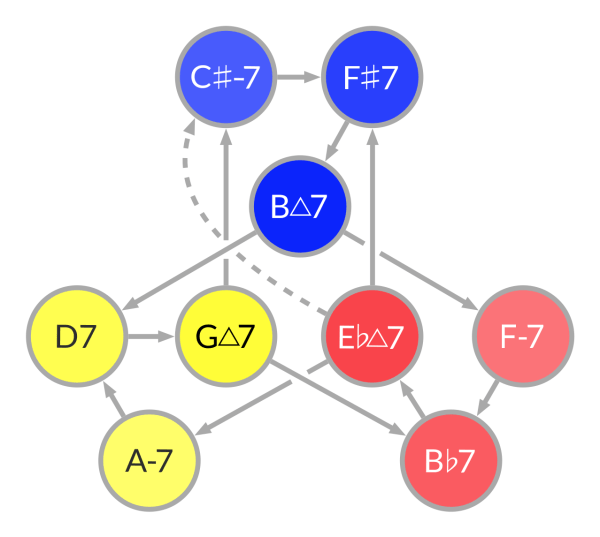
Is “Giant Steps” really the hardest jazz standard to play?

Image courtesy of Ethan Hein

For rock guitarists, it’s Van Halen’s “Eruption.” In classical music, it’s “Flight of the Bumblebee.” For bluegrass banjo pickers, “Foggy Mountain Breakdown.” Every genre of music has one work that, more than any other, serves as a rite of passage. You don’t have to spend years in the jazz community to know which tune fits that role.

Whether John Coltrane’s “Giant Steps” is the most difficult jazz standard of all time is a matter of opinion, but most would agree that more than any other contender, its name serves as shorthand for improvisation intimidation. Vox calles it “the most feared song in jazz.” The Jamey Aebersold series has a volume devoted entirely to helping students master the progression. Ever since pianist Tommy Flanagan struggled with the changes at the original recording session, jazz musicians have seen mastery of the “Coltrane Progression” as the genre’s holy grail. Like ultra-marathoners or actors who have worked for a notoriously demanding director, most jazz musicians have a “Giant Steps” war story or two. The tune has been a reference point for more than half a century. How many jazz standards become memes?

Since the 60th anniversary edition of Giant Steps with the all the  previously unreleased alternate takes drops today, I reckon Flanagan memes  are back on the table : jazzcirclejerk

What makes “Giant Steps” difficult? The two main things are that it is usually played very fast (Coltrane’s original recording was north of 300 beats per minute) and that the chord progression constantly jumps from one key center to another, making it an obstacle course for the improviser. Once the musician can navigate the chord changes, there is the challenge of making it their own. Since ‘Trane, multiple generations of musicians from Pat Metheny to New York Voices have performed and recorded it, so saying something new musically with it is not easy. 

All that being said, what are the advantages of learning “Giant Steps” more than 60 years after it was first recorded? 

Even those who never plan on performing “Giant Steps” can still glean benefits from learning it.  While every chord progression presents its own requirements, the process of acclimating to “Giant Steps” – finding an approach, practicing and perfecting it – and the musical vocabulary developed as a result can be applied almost anywhere: bluegrass, metal and more. Think of the Farmers Insurance commercial – “We know a thing or two because we’ve seen a thing or two.”

Spending time with “Giant Steps” can also provide a lesson in musical history. Like most seemingly radical innovations, “Giant Steps” didn’t come out of nowhere. Wikipedia cites Rodgers and Hart’s “Have You Met Miss Jones” as an influence: “The song’s bridge, featuring key motion by thirds, may have served as an inspiration to John Coltrane in the development of the ‘Coltrane changes.'” Going back even farther, Coltrane was also influenced by Nicolas Slonimsky’s “Thesaurus of Scales and Melodic Patterns.” Musicians who worked with Coltrane during the “Giant Steps” era report that he carried the book around everywhere. 

Another advantage of playing “Giant Steps” is that after spending time with it, almost everything else will seem effortless by comparison, just as after training at high altitudes, an athlete will find competing at sea level to be easier. There’s an old joke about a guy hitting himself with a hammer. When asked why he is hitting himself with a hammer, he says, “It feels so good when I stop.”

Since “Giant Steps” several challenging jazz tunes have entered the literature and shown some staying power. Jaco Pastorius’s “Teen Town” is a benchmark for bassists, as is Mike Stern’s “Chromazone” for guitarists and Michael Brecker’s “Syzygy” for saxophonists. Still, it seems unlikely that another standard will capture the imagination of the jazz world quite as “Giant Steps” did. As the study of jazz continues to grow in years to come, so will “Giant Steps” and its infamous and inspiring legacy.

What are some ways to break out of “ruts” in improvisation?

It’s easy to get stuck in a routine. You find something that works and you want to stick to it. You rely on the same few riffs for your solos and they get you through the gig–but ultimately you want more. We have seen many students go through this; even veteran musicians feel stuck from time to time. We’ve had those moments ourselves. To that point, here are a few ideas about how to break out of ruts and come up with fresh new improvisational ideas.

Practice the chord progression slower. When you take a familiar chord progression – a 12-bar blues, a jazz standard, a modal progression – and play it slower than you are used to, you will hear it differently.  Your phrasing and note choice will automatically sound unlike how it sounded before.  Riffs that sound good at 120 beats per minute might not sound as good at 80 and vice versa.  You may find it awkward and not like how it sounds, but as with any part of your musical experience, ideas and concepts often have to feel uncomfortable before they feel comfortable.  You can also try playing the progression faster than you are used to, but since it’s usually more of a challenge to play slowly, try doing that first.

Practice the chord progression in different keys. Being comfortable improvising in any key is a great benchmark for any musician to attain.  Certain instruments are aligned to play well in specific keys – “C” for the piano; “E” or “A” for guitar; “G” for banjo; “B-Flat” for trumpet, etc.  If you are playing in a key that is friendly to your instrument, it’s easy to revert to familiar riffs.  If you force yourself outside of that comfort zone, you may discover new ideas that you can translate back to the original key.

One note. There’s a lot of focus on: “What scale should I play?  What tensions should I use?”  This is important stuff, but there’s plenty more that goes into an effective solo.  By picking just one note and creating a solo with it, you can focus on dynamics, phrasing, articulation and other elements of improvisation that sometimes take a back seat to note choice.

Two on, two off.  Solo for two measures; leave space for two measures.  Get used to the sound of space; it is a valuable improvisational tool.

Sing along. If you are playing piano, guitar or any other non-wind instrument, sing along with yourself as you play.  It will force you to play lines that are more purposeful.  If you play a wind instrument, try singing along to the chord progression and then improvising over it; you may find that singing, instead of being tied to your instrument, gives you new ideas.

W.W.T.D.? What would Trane do?  Or Miles?  Hendrix?  Metheny?  Stevie Ray?  Listen, transcribe and find out.

Take a break.   You don’t have to solo on every single song your band or ensemble plays.  If you knew that during your set you would only have one or two solos, you would likely save your best ideas for them.  Plus, allowing other people the chance to solo in your stead will make you very popular on the bandstand.

“What are some good online resources for practicing improvisation?”

Ah, if I only had a Jamey Aebersold play-along for every time I was asked this, I’d have the whole series.

Practicing and playing music with your friends can be difficult.  Finding a place to play and organizing everyone’s schedules can be tricky and on top of that, all of the musicians need to be of similar ability levels and have compatible goals and interests.  Many community colleges and local music schools offer classes in jazz and other contemporary styles but while these can be valuable resources, they might not provide you with the individualized attention you need.  A good private teacher can be a tremendous help, but not everyone has the money for that.

However, the good news is that there are many great online resources to help students practice improvisation. While cyberspace can’t provide the experience of interacting face-to-face with other musicians or give you feedback on your performance, it can be a reasonable alternative especially if you have limited opportunities to play in ensembles.

Learn Jazz Standards has an extensive collection of Youtube videos containing play-along tracks and a website where students can download chord charts for free and play-along tracks for $1.99.  The site also contains videos for each song that help students get more in-depth looks at the chord progressions.

QG Videos also features play-along tracks to jazz standards; the videos show the chord charts for the tunes.  The Youtube channel offers several alternative versions of each track, including up tempo or slow and no piano.

Sometimes you might not want to practice an entire chord progression but just a section, such as a “ii-V-I” progression.  Learn Jazz Now’s channel features several such videos, such as this one in the key of C – and for those who want something a little different, the same progression in the key of G-Flat.

Jazz Everyone offers a mix of instructional videos, play-along tracks and downloadable sheet music, including etudes based on popular chord progressions and concepts such as chromaticism and ii-V-I progressions.  Some of the material is free; some of it can be accessed with a paid membership.

Jazz Practice Loops also offers play-along tracks, including ii-V-I progressions in all twelve keys as well as several articles about theory, scales, intervals and more.

While it’s not as interactive, Jazz Advice features articles about many aspects of musicianship, improvisation and jazz.  including this one about how to hear chord changes and this list of ten essential jazz standards.

What about resources for smartphones for musicians on the go?  Jazz Apps Mobile offers a series of fairly inexpensive apps that focus on aspects of improvisation including scales, progressions and even a jazz theory quiz.

These are just a few of the many products and sites available to help musicians with improvisation.  Technology has made us a global society and music is the universal language so it’s only natural that cyberspace can provide the answers to the challenges one faces in becoming a great musician.

It should be noted that the sites listed above were picked by Outside Pedestrian because of their musical and educational value.  The band did not accept any compensation or recognition by any of the publishers.  However, if any of said publishers happen to be reading this and would like to reciprocate us in any way, feel free to.

Blog at WordPress.com.

Up ↑