Recognizing, understanding and creating jazz contrafacts


The term “contrafact” is defined by Wikipedia as “a musical work based on a prior work.” In jazz, the word is often used to describe a tune that uses an existing composition’s chord progression. A songwriter or composer can use an existing chord progression as a starting point for a new piece, while musicians learning a tune that is a contrafact can gain additional insight by comparing it to its source. Note that from a copyright standpoint, chord progressions are not considered specific enough to qualify as intellectual property, so as long as the composer creates an original melody, they are exempt from charges of plagiarism.

In this post, we will discuss two common chord progressions: the 12-bar blues and the “I Got Rhythm” changes, then explore some specific examples of contrafacts.

Blues progressions

Blues music, in particular the 12-bar progression, has served as the foundation of many songs throughout jazz, country, bluegrass, rock and other genres. Works that are based on this progression usually have three things in common: starting on the I chord (the home key), moving to the IV chord in the fifth bar and a turnaround starting in the 9th bar: a phrase that “answers” the statements if the previous two phrases and sets up a return to the top of the form.

Following are three examples of the 12-bar blues progression in the key of F. The first is a basic example. The second is Charlie Parker’s tune “Au Privave” which shares the same outline as the first example but has more active harmonic movement. The third, “Blues for Alice” is another Parker head with the same framework, but still more movement.

Comparing “Au Privave” (a typical example of “be-bop” blues) to the simpler blues progression, we see differences, but also some similarities. Both of these progressions:

  • Start on the I chord (F)
  • Go to the IV chord (Bb) in the 5th measure
  • Return to the I chord in the 7th measure
  • Start the turnaround phrase in the 9th measure

The first progression uses a V – IV – I turnaround (the 9th measure has a C7, or V7 chord; the 10th measure has Bb7, the IV chord and the 11th measure returns to the I chord) while “Au Privave” uses a ii – V7 – I turnaround (starting on the Gm7, or ii chord, then going to the C7, or V7 chord, then resolving to the F7, or I chord.)

Comparing “Au Privave” to “Blues for Alice” we again notice similarities and differences. The progression starts on the I chord as the other two do, but it quickly moves through several harmonies before resolving on the IV chord in measure 5. Instead of returning to the I chord in measure 7 as the previous progressions do, it continues to explore new harmonic terrain before arriving at the ii chord in measure 9 as “Au Privave” does. From that point on out, it follows the same progression as “Au Privave.”

As a performer, understanding how a simple blues progression can evolve into a more elaborate one such as “Blues for Alice” can help you see the progression as a whole, enabling you to not worry too much about each individual chord. As a composer, seeing how far you can go from the original blues progression and still have the basic framework intact can give you ideas about how to stretch your raw materials farther.

“I Got Rhythm”

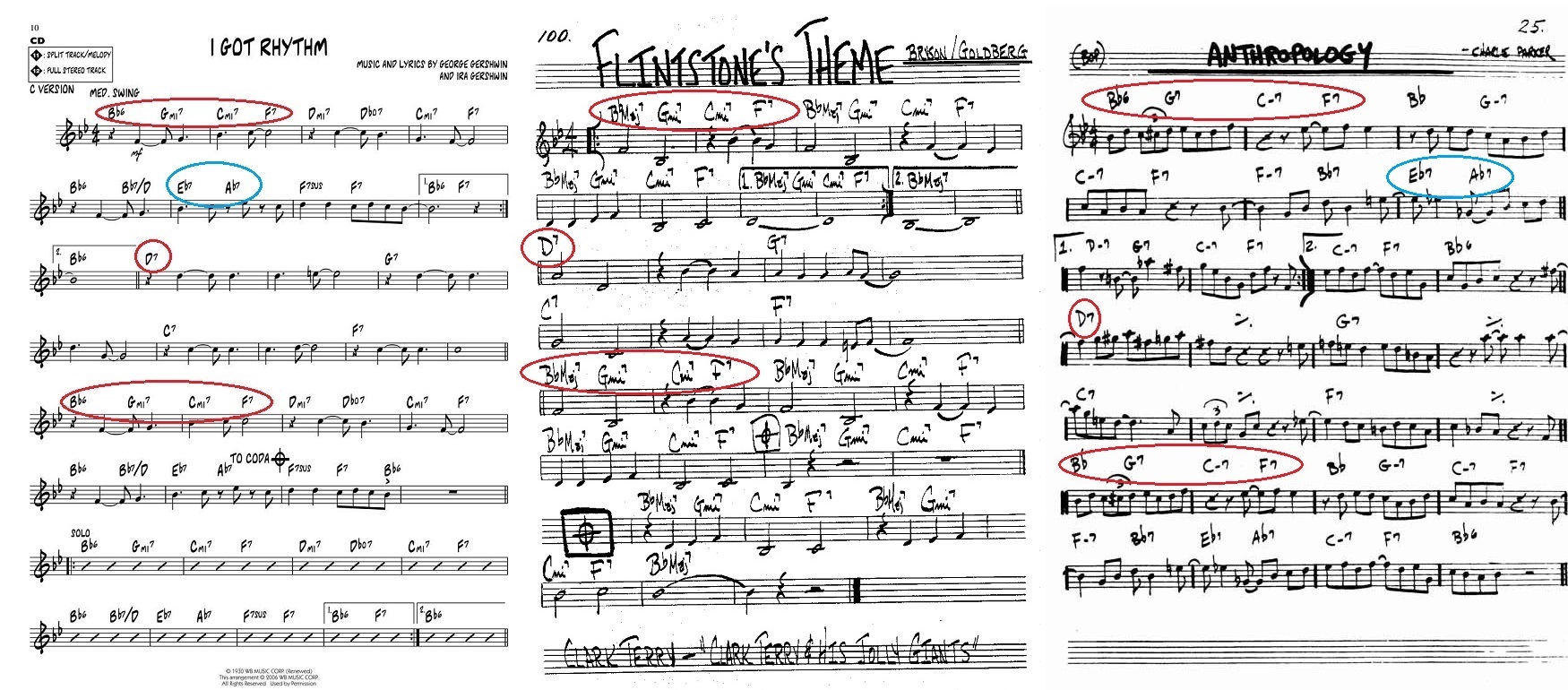
Gershwin’s “I Got Rhythm” has a chord progression that has been used by many jazz musicians as the basis for their own compositions. The theme from “The Flintstones” is a commonly cited example of “Rhythm Changes.” Other famous be-bop standards that use Rhythm Changes include “Oleo” by Sonny Rollins and “Anthropology” by Charlie Parker. A more recent example is saxophonist Alison Young’s “One Night Stan.” The progression also made its way into rock’n’roll with the Four Seasons’ “Sherry.” 

Comparing “I Got Rhythm” to “Flintstones” and “Anthropology” we see several parallels. All three follow a 32-bar “A-A-B-A” form. The “A” sections consist of a repeated two bar I-vi-ii-V7 progression (Bb6 – G7 or Gm7 – Cm7 – F7). In “I Got Rhythm” and “Anthropology” there’s the slight variation (circled in blue) of going to the Eb7 and Ab7 chords in the 6th measure. These tunes all have bridges that follow a III7-VI7-II7-V7 progression (D7 – G7 – C7 – F7) with each chord being held for two bars. Changing up the harmonic rhythm from one section to another (note how the chords in the “A” section move quickly while the chords in the “B” section last for longer) is a useful compositional tool to keep in mind should you feel stuck. 
Other be-bop era examples

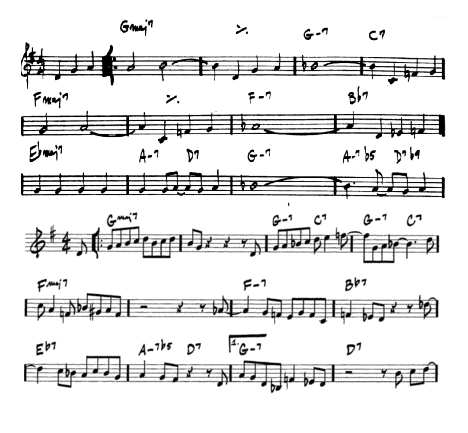
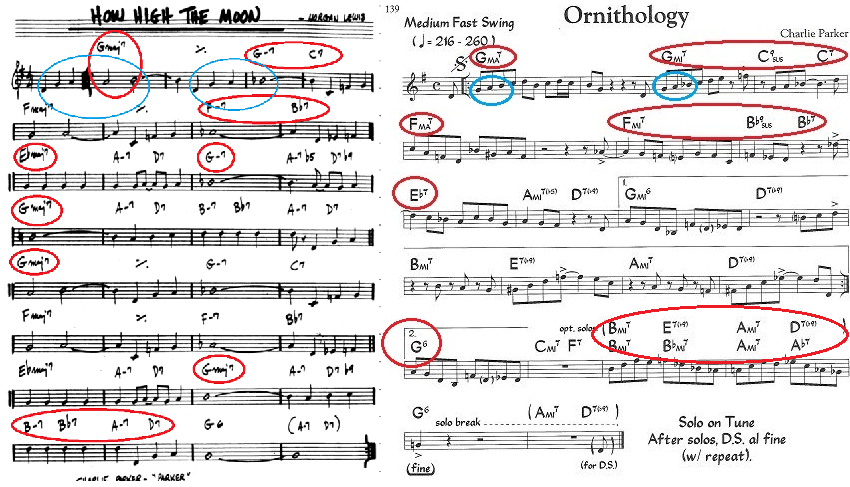
Several Great American Songbook era standards were used by the first generation of be-bop musicians (Charlie Parker, Dizzy Gillespie, Miles Davis et. al) as the basis for new compositions. A famous example is Parker’s tune “Ornithology”, based on “How High The Moon.” Comparing the two, we see some similarities. Both use 32-bar A-B-A-C (or A-B-A-B’) forms. Both start in the key of G, then switch from major to minor in the 3rd bar, setting up a move to F in the 5th bar. Another major to minor move in bar 7 brings us to E-flat in the 9th bar. The melody of “Ornithology” echoes “How High the Moon”’s D-G-A-B figure (circled in blue) in the first bar and the D-G-A-Bb figure in the third bar when the harmony shifts to minor.
The roots of a contrafact can be a little harder to trace when the new composition is in a different key than the original. However, by looking at relationships between the chords, we can still see parallels. An example of this is Parker’s “Donna Lee”, composed and usually played in the key of A-flat and based on “(Back Home Again in) Indiana”, usually played in the key of F. Though they look different, closer examination reveals that they follow the same blueprint. Like the pair discussed above, both are 32-bar A-B-A-C tunes. Both start with a I-VI7-II7 cadence (F – D7 – G7 or Abmaj7 – F7 – Bb7), then return to the I chord in bar 7. Both arrive at the IV chord in bar 9, use either the #iv diminished or the iv minor chord in bar 10 and return to the I chord in bar 11 before an extended turnaround sets up the next A section. At bar 23, both tunes have modulated into the relative minor (d for “Indiana” and f for “Donna Lee.”) Both tunes use a diminished chord in bar 28 as a pivot to return to the home key at the end of the form.

As a composer, comparing “Donna Lee” and “Indiana” can provide valuable insight into how one piece of music can be elaborated upon and transformed into something else. As an improvisation-oriented performer, understanding the roots of “Donna Lee” – a tune that has something of an intimidating reputation in jazz circles – can help give the musician a place to start learning it.

“Jake’s Shuffle”

Composer David Lockeretz on “Jake’s Shuffle”

I had a young student named Jake who was a fan of classic rock and blues. One day I came up with a riff that I thought he’d have fun playing. The riff sounded like it belonged on the turnaround of a Delta-style blues progression, but I decided to make it the main riff of the tune rather than using it as the turnaround. When I was messing with it, I decided to stay in the I chord instead of going to the IV chord in the fifth bar, as would be typical for a blues progression. I was in the key of D, with drop-D tuning, which Jake enjoyed, and that got me thinking about “So What” and “Impressions” – the two seminal modal jazz tunes, both of which are in that key. I decided to take that modal progression – 16 bars of D, 8 bars of Eb, 8 bars of D – and play it with the blues feel. I did some things to change it up a little – I started off with a vamp, brought in an element of orchestration by having the bass double the guitar on the turnaround line and I also wrote a new melody on the bridge, whereas “So What” and “Impressions” play the melody up a half step on the bridge. Long story short: “Jake’s Shuffle” didn’t start out as a contrafact, per se, but as I was developing it I realized that it might work with the modal progression. Once I saw that, it gave the tune a ready-made outline.

Additional resources

Articles with examples and analysis here and here

Article about baritone saxophonist and prolific contrafact composer Gary Smulyan here

Partial list of notable jazz contrafacts here

Playlist with contrafacts paired with their source material here

One last example

“Tide” by Antonio Carlos Jobim is a Latin jazz contrafact. Listen to it and see if you can identify the original progression and its composer.


What are some ways to break out of “ruts” in improvisation?

It’s easy to get stuck in a routine. You find something that works and you want to stick to it. You rely on the same few riffs for your solos and they get you through the gig–but ultimately you want more. We have seen many students go through this; even veteran musicians feel stuck from time to time. We’ve had those moments ourselves. To that point, here are a few ideas about how to break out of ruts and come up with fresh new improvisational ideas.

Practice the chord progression slower. When you take a familiar chord progression – a 12-bar blues, a jazz standard, a modal progression – and play it slower than you are used to, you will hear it differently.  Your phrasing and note choice will automatically sound unlike how it sounded before.  Riffs that sound good at 120 beats per minute might not sound as good at 80 and vice versa.  You may find it awkward and not like how it sounds, but as with any part of your musical experience, ideas and concepts often have to feel uncomfortable before they feel comfortable.  You can also try playing the progression faster than you are used to, but since it’s usually more of a challenge to play slowly, try doing that first.

Practice the chord progression in different keys. Being comfortable improvising in any key is a great benchmark for any musician to attain.  Certain instruments are aligned to play well in specific keys – “C” for the piano; “E” or “A” for guitar; “G” for banjo; “B-Flat” for trumpet, etc.  If you are playing in a key that is friendly to your instrument, it’s easy to revert to familiar riffs.  If you force yourself outside of that comfort zone, you may discover new ideas that you can translate back to the original key.

One note. There’s a lot of focus on: “What scale should I play?  What tensions should I use?”  This is important stuff, but there’s plenty more that goes into an effective solo.  By picking just one note and creating a solo with it, you can focus on dynamics, phrasing, articulation and other elements of improvisation that sometimes take a back seat to note choice.

Two on, two off.  Solo for two measures; leave space for two measures.  Get used to the sound of space; it is a valuable improvisational tool.

Sing along. If you are playing piano, guitar or any other non-wind instrument, sing along with yourself as you play.  It will force you to play lines that are more purposeful.  If you play a wind instrument, try singing along to the chord progression and then improvising over it; you may find that singing, instead of being tied to your instrument, gives you new ideas.

W.W.T.D.? What would Trane do?  Or Miles?  Hendrix?  Metheny?  Stevie Ray?  Listen, transcribe and find out.

Take a break.   You don’t have to solo on every single song your band or ensemble plays.  If you knew that during your set you would only have one or two solos, you would likely save your best ideas for them.  Plus, allowing other people the chance to solo in your stead will make you very popular on the bandstand.

“How can I bring my B-Double Flat game to understanding accidentals?”

Okay, maybe we haven’t been asked that exact question, but in the classroom and in private lesson settings, we have often seen confusion about accidentals. When is a note called C sharp, when is it called D flat, and why does any of that matter?

Just because two notes sound the same, that doesn’t mean that they are the same. Words such as “red/read”, “two/too/to” and “be/bee” sound the same but are different. While the ear perceives C-sharp and D-flat the same way, if you are writing music for others to read, it is important to understand the difference.

RULES

Every modal scale (major, minor, mixolydian, etc) scale MUST have exactly one of every note letter: one A, one B, one C and so forth. For example, a D major scale must be spelled D – E – F# – G – A – B – C#. The F# cannot be called G-flat because then the scale would have two Gs (one flat, one natural) and no Fs; the C# cannot be called D-flat for the same reason.

accidental examples scales

Even scales that are not derived from modes such as melodic and harmonic minor must follow the same model. For example, an A harmonic minor scale must be spelled A – B – C – D – E – F – G#, because if the last note was spelled as A-flat, there would be no G and there would be two As.

When accidentals are used for notes non-diatonic to the key (F# in the key of C) the same rules apply, even if it is not as obvious. In “The Star Spangled Banner” it is correct to call the note above “The dawn’s earLY light” F# and not G-flat. F# is easier to read more closely related to the key of C than G-flat.Accidentals Examples Star Spangled Banner.jpg

CONVENTIONS

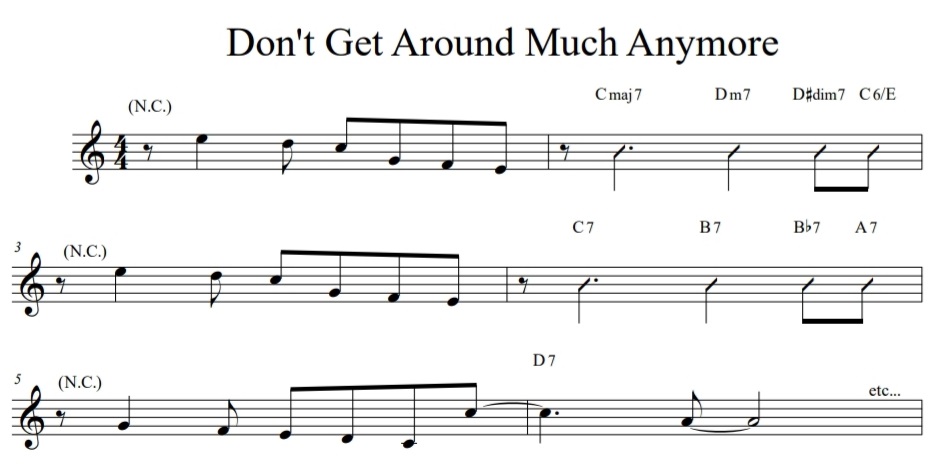
In jazz and popular music, the rules are not as hard and fast, but it is still good to understand conventions of writing accidentals. A common example is in chromatic chord progressions. It is considered easier to read to use flats when descending and sharps when ascending. In this excerpt from Duke Ellington’s jazz standard “Don’t Get Around Much Anymore” we see that the opening sequence of chords uses a D# between the Dm7 and C6/E chord (ascending) while the next sequence (descending) uses Bb7 between the B7 and A7 chords.

dgama example

WHEN SHARPS AND FLATS ACT NATURALLY

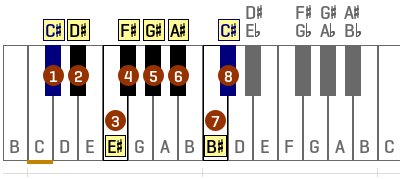
Though it doesn’t often happen, a note with “flat” or “sharp” in its name can actually be a white key on the piano – that is to say, much more often known by another name. Below, we see an example (image from Basic Music Theory) of how a C# major scale looks on the piano. Notice how the E# is played on the key that would commonly be called “F” and the B# is played on the key that would commonly be called “C”. As discussed above, all major and minor scales must have one of every letter name and C# is no exception. Even though it would be tempting to call the note “F” out of familiarity, it is correct to call it E# for this reason.

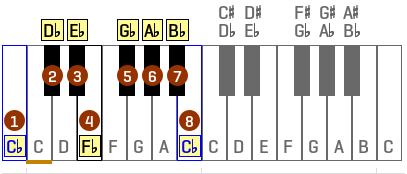
c-sharp-major-scale-on-piano-keyboardWe see the opposite in the C-flat major scale. The note that would more commonly be called “B” becomes C-flat and the “E” becomes F-flat.
c-flat-major-scale-on-piano-keyboard

Another way to think about it: to sharp a note, any note, is to raise the pitch by half a step and to flat a note is to lower it by half a step. This is true for black and white keys alike.

DOUBLE TROUBLE

If you’re ever reading through music and see two flat signs right next to each other before a note, you may think it’s a misprint. It’s not. It’s a double flat, which, like its counterpart the double sharp, is very rare but real nonetheless.

double sharp double flatOutside of J.S. Bach’s “Well Tempered Clavier”, certain piano works by Chopin and Rachmaninoff and “The Black Page” by Frank Zappa, the area where one is most likely to find double sharps and flats is in diminished and augmented chords. An augmented triad, like other triads, consists of the first, third and fifth degrees of the scale. The “augmentation” occurs when the fifth is raised a half step compared to a major triad. In the example below, we see an F# triad (F#, A#, C#) leading to an F# augmented triad (F#, A#, C double-sharp). Strictly speaking, it is correct to call the top note of the F# augmented triad C double-sharp and not D, even though they sound the same. Theoretically, it is considered a sharp fifth and not a flat sixth. If the natural fifth is C#, the sharp (or augmented fifth) is C double-sharp.

double sharp exampleThis example illustrates the same idea, with a diminished seventh chord.

diminished chord exampleBecause a seventh chord consists of the first, third, fifth and seventh degrees of the scale, it is technically correct to label the top note as a doubly-flatted 7th degree (B double-flat) instead of a natural 6th degree (A).

(Both images above courtesy of Practical Chords and Harmony)

TWO MNEMONICS TO HELP YOU REMEMBER SHARPS AND FLATS

If you have been playing music long enough, you have probably noticed that certain sharps, such as F and C, tend to be more common, as are flats such as B and E. That’s because on the Circle of Fifths, which maps out the relationship all keys have to each other,  flats and sharps are always added in the same order. If a key signature is one sharp (G major, e minor) it is always F. If a key signature is two sharps, they will always be F and C and so forth, all the way up to seven. The same is true of flats, only in the opposite direction: F major and d minor have only one flat, B; Bb major and g minor have two flats (B and E) and so forth. These are also notes you are most likely to see as accidentals and that goes for double sharps and flats as well. If you’re going to see any double sharp, it will probably be F and if you see any double flat, it will probably be B.

To remember the order of the flats and sharps, try the following mnemonics:

(Flats – B E A D G C F)

Be Ever Alert During Guitar Class Fool

(Sharps – F C G D A E B)

Fine Classic Guitarists Demand Accurate Execution Baby

Good luck with your double sharps and flats and feel free to leave any questions or comments below.


“If I’m a pop/rock songwriter, should I still learn about music theory?”

Guest writers are always welcome to contribute to “Ask OP” as we value the diversity of perspectives and experiences and aim to make this section of the site as valuable and interesting as possible. We are proud to welcome Greg Daulton for this post. Originally a self-described “metal guy from Oakland”, Greg hadn’t studied any theory before attending Berklee College of Music, where “having to play catch-up” forced him to find “practical application of the techniques and theory studied,” which in turn influenced his philosophy as an educator. At Berklee, he completed an honors degree in film scoring. Currently Greg lives in Orange County and is the founder of The Rock Band Experience, a program where students form bands, write and perform original music. Greg is also the author of “The Complete Guide to Modern Songwriting.” He can be reached by email for more information about his projects.

One question I get asked all the time from aspiring musicians and students is:

“If I’m going to be a rock/pop star why do I need to know music theory?”

While the mention of music theory may seem intimidating to the emerging musician, it doesn’t necessary refer to the studies of fugue or species counterpoint. True, countless bands have put out tons of great music with little to no formal education but the techniques employed by these artists generally DO tend to follow the concepts studied in music theory whether they know it or not. No matter what instrument you play, understanding and applying theory can help you and your bandmates sound better.

Johnny Cash once said, “There’s no money past the third fret.” However, guitarists who can spell and construct chords will discover that the same shapes found in open chords may be played anywhere on the fretboard. This broadens the guitarist’s palette by facilitating different voicings in different registers and it also enables branching out beyond the common keys of “A”, “C”, “D”, “E” and “G”, providing a good weapon against songwriter’s block.

Understanding the characteristic sound and construction of scales and being fluent with them can help guitarists, keyboardists and bassists elaborate on musical ideas when playing lead or accompanying melodies. By understanding the relationship of diatonic notes to non-diatonic notes, musicians acquire the ability to create tension and release, add dissonance and make their ideas more vibrant.

Do drummers get a free pass from learning theory? Absolutely not! At the very least, a good drummer understands song form and can set up choruses, pre-choruses and other sections appropriately. Understanding beat placement and subdivisions is also important; supposedly Pete Best’s inability to play anything other than quarter notes on his bass drum was one of the reasons he was fired from the Beatles. Good drummers are adept with, or at least have an understanding of, odd times and polyrhythms; many working cover bands play songs such as Pink Floyd’s “Money” (7/4 time) and Led Zeppelin’s “Kashmir” (3/4 over 4/4). In the Doors’ “Light My Fire”, drummer John Densmore accents organist Ray Manzarek’s solo with some polyrhythmic figures, helping to build excitement. Lastly, remember that since drummers are often the butt of musician jokes (“how do you know when the stage is level? The drool comes out of both sides of the drummer’s mouth”) you can do your percussionist brothers and sisters proud by mastering theory and out-geeking your lead guitarist.

Each instrumentalist has their own contribution to make to the group’s collective sound: the bass line connects the drum beat and the harmony while the harmony connects the rhythm section to the melodic lines. Players who understand the inner workings of music can help their band break away from the traditional formulas of pop and rock and help create memorable exciting music that stands out from the masses.

“How do you get started with jazz improvisation?”

At one of our College of the Desert clinic, we were asked this question by a student. While there are many possible answers to that question, here are a few of our thoughts.

“The biggest thing to remember with improvisation is that there ARE no wrong notes. There may be notes that sound better than others, but a great musician can ‘sell’ a note that’s not ‘supposed’ to go over a certain chord or harmony. Notes also make up only part of what a musician communicates. Don’t forget phrasing, tone, dynamics, rhythm and space.

For some students, the ‘blank canvas’ of improvisation can be a little intimidating, just as for the novice jazz listener it can be hard to understand exactly what’s going on in a Bird or Coltrane solo. The more you listen to jazz, whether on recording or live, the more you will pick up.

Start by quoting the melody of the tune. This can make your solo feel more coherent; you’re trying to tell the audience a story, not just show them how fast you can play. For guitarists, pianists, vibraphonists, bassists and other non-wind instrumentalists, try singing along as you play. It doesn’t have to be perfect; that’s not the point. The point is that by singing along with your line, you’re likely to play more musically. Every note and phrase you play will have a purpose, even if they’re not executed 100% accurately. For phrasing, try the “two on, two off” exercise – that is to say, on a progression such as a 12-bar blues or a jazz standard, solo for two bars and then rest for two, as if you’re trading with a drummer.

As for the language of jazz and the ability to navigate over chords, there are many transcriptions of great jazz solos available. The Charlie Parker Omnibook is a good place to start. Playing the arpeggios of chord symbols (Cm7 = C, Eb, G, Bb; F7 = F, A, C, Eb; Bbmaj7 = Bb, D, F, A) is a good exercise too. In addition to reading the transcriptions of other soloists, try transcribing solos yourself–and not just those played on your own instrument.

Realize that trial and error is part of the learning process. With software such as Garage Band, it’s possible to record yourself improvising along to existing tracks. Some of what you play won’t work; some of it will probably make you cringe, but that’s how you grow.”

Blog at WordPress.com.

Up ↑