
Okay, maybe we haven’t been asked that exact question, but in the classroom and in private lesson settings, we have often seen confusion about accidentals. When is a note called C sharp, when is it called D flat, and why does any of that matter?
Just because two notes sound the same, that doesn’t mean that they are the same. Words such as “red/read”, “two/too/to” and “be/bee” sound the same but are different. While the ear perceives C-sharp and D-flat the same way, if you are writing music for others to read, it is important to understand the difference.
RULES
Every modal scale (major, minor, mixolydian, etc) scale MUST have exactly one of every note letter: one A, one B, one C and so forth. For example, a D major scale must be spelled D – E – F# – G – A – B – C#. The F# cannot be called G-flat because then the scale would have two Gs (one flat, one natural) and no Fs; the C# cannot be called D-flat for the same reason.

Even scales that are not derived from modes such as melodic and harmonic minor must follow the same model. For example, an A harmonic minor scale must be spelled A – B – C – D – E – F – G#, because if the last note was spelled as A-flat, there would be no G and there would be two As.
When accidentals are used for notes non-diatonic to the key (F# in the key of C) the same rules apply, even if it is not as obvious. In “The Star Spangled Banner” it is correct to call the note above “The dawn’s earLY light” F# and not G-flat. F# is easier to read more closely related to the key of C than G-flat.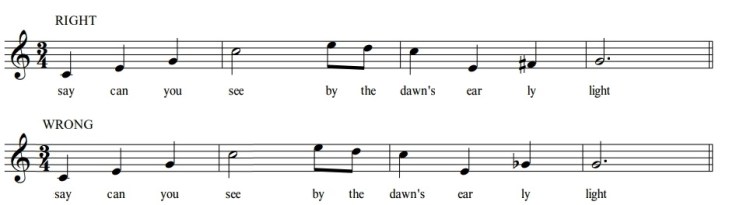
CONVENTIONS
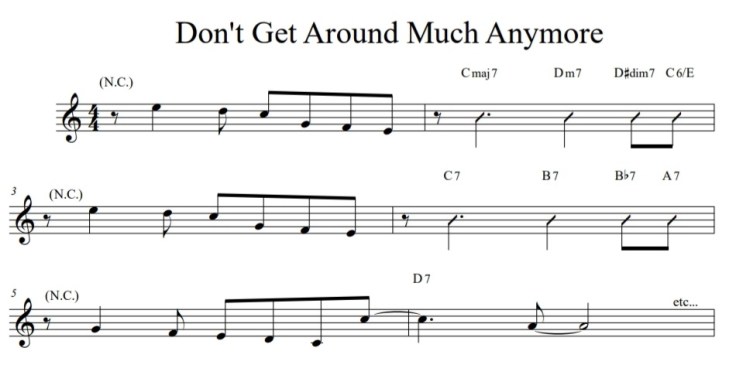
In jazz and popular music, the rules are not as hard and fast, but it is still good to understand conventions of writing accidentals. A common example is in chromatic chord progressions. It is considered easier to read to use flats when descending and sharps when ascending. In this excerpt from Duke Ellington’s jazz standard “Don’t Get Around Much Anymore” we see that the opening sequence of chords uses a D# between the Dm7 and C6/E chord (ascending) while the next sequence (descending) uses Bb7 between the B7 and A7 chords.
WHEN SHARPS AND FLATS ACT NATURALLY
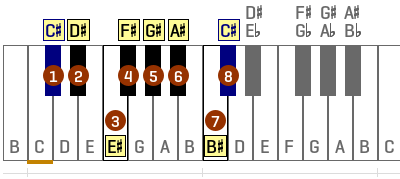
Though it doesn’t often happen, a note with “flat” or “sharp” in its name can actually be a white key on the piano – that is to say, much more often known by another name. Below, we see an example (image from Basic Music Theory) of how a C# major scale looks on the piano. Notice how the E# is played on the key that would commonly be called “F” and the B# is played on the key that would commonly be called “C”. As discussed above, all major and minor scales must have one of every letter name and C# is no exception. Even though it would be tempting to call the note “F” out of familiarity, it is correct to call it E# for this reason.
 We see the opposite in the C-flat major scale. The note that would more commonly be called “B” becomes C-flat and the “E” becomes F-flat.
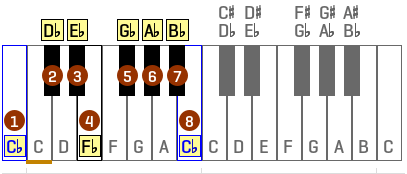
Another way to think about it: to sharp a note, any note, is to raise the pitch by half a step and to flat a note is to lower it by half a step. This is true for black and white keys alike.
DOUBLE TROUBLE
If you’re ever reading through music and see two flat signs right next to each other before a note, you may think it’s a misprint. It’s not. It’s a double flat, which, like its counterpart the double sharp, is very rare but real nonetheless.
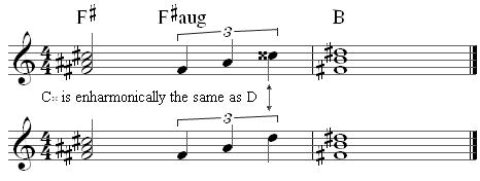
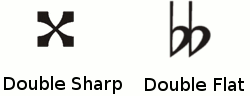 Outside of J.S. Bach’s “Well Tempered Clavier”, certain piano works by Chopin and Rachmaninoff and “The Black Page” by Frank Zappa, the area where one is most likely to find double sharps and flats is in diminished and augmented chords. An augmented triad, like other triads, consists of the first, third and fifth degrees of the scale. The “augmentation” occurs when the fifth is raised a half step compared to a major triad. In the example below, we see an F# triad (F#, A#, C#) leading to an F# augmented triad (F#, A#, C double-sharp). Strictly speaking, it is correct to call the top note of the F# augmented triad C double-sharp and not D, even though they sound the same. Theoretically, it is considered a sharp fifth and not a flat sixth. If the natural fifth is C#, the sharp (or augmented fifth) is C double-sharp.
 This example illustrates the same idea, with a diminished seventh chord.
 Because a seventh chord consists of the first, third, fifth and seventh degrees of the scale, it is technically correct to label the top note as a doubly-flatted 7th degree (B double-flat) instead of a natural 6th degree (A).
(Both images above courtesy of Practical Chords and Harmony)
TWO MNEMONICS TO HELP YOU REMEMBER SHARPS AND FLATS
If you have been playing music long enough, you have probably noticed that certain sharps, such as F and C, tend to be more common, as are flats such as B and E. That’s because on the Circle of Fifths, which maps out the relationship all keys have to each other, flats and sharps are always added in the same order. If a key signature is one sharp (G major, e minor) it is always F. If a key signature is two sharps, they will always be F and C and so forth, all the way up to seven. The same is true of flats, only in the opposite direction: F major and d minor have only one flat, B; Bb major and g minor have two flats (B and E) and so forth. These are also notes you are most likely to see as accidentals and that goes for double sharps and flats as well. If you’re going to see any double sharp, it will probably be F and if you see any double flat, it will probably be B.
To remember the order of the flats and sharps, try the following mnemonics:
(Flats – B E A D G C F)
Be Ever Alert During Guitar Class Fool
(Sharps – F C G D A E B)
Fine Classic Guitarists Demand Accurate Execution Baby
Good luck with your double sharps and flats and feel free to leave any questions or comments below.


 Outside Pedestrian