
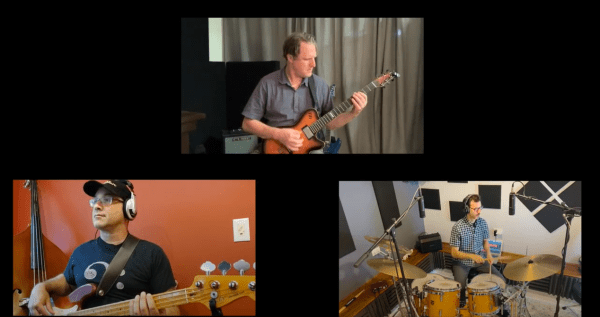
The last “Ask O.P.” focused on some of the technical challenges we encountered in creating our remote performance video of our arrangement of J.S. Bach’ “Jesu, Joy of Man’s Desiring.” In this post, we will discuss some of the creative challenges of working remotely.
Why “Jesu?”
At the outset of the 2020 holiday season, we had already created a virtual performance of “Two By Two” from our “Reclaimed” record and had reunited with our original drummer, Steve Tashjian, to record new versions of “Southern California Highway Song” and “Northern California Highway Song” from our first record, “Pedestrian Crossing.” After creating virtual performance videos for both of those songs, we wanted to continue exploring this format but did not have any new material and did not want to simply redo another tune. We decided to take a recognizable but not overplayed holiday song and create our own version of it.
Bach’s “Jesu, Joy of Man’s Desiring” checked several boxes for us. We liked the idea of taking a classical (Baroque era) work and writing a contemporary-sounding arrangement of it; this is in keeping with the trio’s mission statement of modern eclecticism. Both Anthony Fesmire and David Lockeretz have enjoyed exploring the works of J.S. Bach, absorbing his influence as a composer and challenging themselves by playing the difficult melodic lines for which he is famous. Over the summer, the guitarist and bassist recorded virtual duets of two of Bach’s two-part inventions. “Jesu” seemed to be a logical continuation.
The original arrangement
While the final arrangement featured a minor key guitar solo, the original version modulated to E-flat major. The modulation was set up by the final V7 chord (D7) of the first section, moving up half a step to the new key. The same idea was used to transfer to the bass solo: the V7 chord (Bb7) in measure 50 set up the move a half-step higher to the new key of B. With F#7 being the V7 chord in the key of B, the same method could have been used to return to the home key of G major. However, we opted for a drum solo (8 bars open, 8 bars over a melodic figure) before returning to the recapitulation of the melody.
The changes
The first change was to simplify the chord progression for the guitar solo.


The change from major to minor
On one of the Zoom calls in which we discussed the arrangement, the idea of changing the guitar solo to a minor key was brought up. The goal was to create tonal and harmonica variety in a way often done by Bach himself, as seen in this example from the original composition, where the music has left the home key of G major for the new key of A minor.


There was also a debate about whether the drum solo should stay.


After trying a few different things, a drum solo was decided upon and the drum parts for the guitar and bass solo were scrutinized more closely.


Recording logistics also played a role in fine-tuning the arrangement and performance direction.

After a few more exchanges, the arrangement, performances and mixes were finalized.

Finally, the music was mixed and mastered, the videos were made and it was all put together.

David Lockeretz: “It was challenging but rewarding, both creatively and technologically. Musically, it laid the groundwork for us to explore new ways of collaborating as well as for exploring new interpretations of the classical repertoire. We’re all looking forward to being able to record and perform together in person, but in the mean time, we’re grateful to be able to keep our musical connection alive remotely and continue to create new music to share.”


 Outside Pedestrian